

79.00 EUR
This course examines the French Defence Tarrasch Variation (3.Nd2), focusing on the pawn structure that arises after 3...c5 4.exd5 exd5 and the subsequent dxc5, leaving Black with an isolated queen's pawn on d5. It explores the dynamic middlegame potential of this structure alongside its endgame implications, and covers the principal sidelines where White carries the isolated pawn instead.
The Tarrasch Variation, 3.Nd2, is popular at every level for a simple reason: White can play it almost without risk. It suits a positional player who is happy with a small advantage or a balanced but playable game, and it is not easy for Black to create winning chances against it.
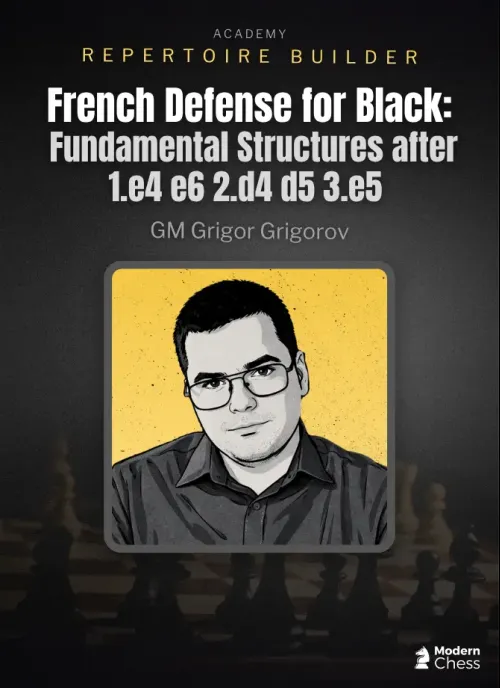
This course, based on the Repertoire Builder camp by GM Grigor Grigorov, continues the French Defence repertoire with an answer that keeps those winning chances: 3...c5 4.exd5 exd5!?, playing with an isolated queen's pawn.
For a long time, strong players avoided 4...exd5 because they believed it led to a passive position. The fashionable 4...Qxd5 solves Black's problems almost mathematically, but it demands a great deal of theory.
The course argues that the French version of the IQP is a different structure from those of the Queen's Gambit or the Caro-Kann Panov, and much more favourable for Black. The reason is one pawn: White has a pawn on c2, not on e3.
From there the plans are clear: ...Re8, ...Bg4, ...Qd6, sometimes ...h6 and ...g5 followed by ...Ne4, with pressure on the e-file and the a7-g1 diagonal.
White's most testing reply is 6.Bb5, which stops Black from developing the knight to f6 at once. After 6...Nf6? 9.Re1+, Black cannot castle and is close to lost.
The recommended answer is 6...Qe7+!, an idea that Vladimir Kramnik brought to modern top-level chess. It forces White to choose between two moves, and both have drawbacks:
Kramnik played 6...Qe7+ repeatedly in his blitz match against Jose Eduardo Martinez Alcantara. GM Grigorov studied the line seriously after that match, and the course examines those games in detail, including where his own preferences differ from Kramnik's.
White's sidelines lead to different structures, and each is treated on its own terms:
The model games span generations: Karpov and Korchnoi in their world championship matches, Uhlmann, Portisch and Yusupov, Mihail Marin's own practice, and recent games from Titled Tuesday. Several of the classical examples were annotated together with GM Mihail Marin, who also prepared the test positions.
This course is part of GM Grigorov's French Defence project in Repertoire Builder. August covered the closed chain of the Advance, September the principled 3.Nc3, and the Tarrasch completes Black's answer to White's main systems with one consistent idea: playing for the initiative from a sound structure.
Add French Defense for Black – Fundamental Structures in the Tarrasch Variation to your repertoire and meet 3.Nd2 with a plan, not just a line.
Extra 5% off on 2 or more courses from this series in one order, on top of the quantity discount.