
49.00 EUR 36.80 EUR
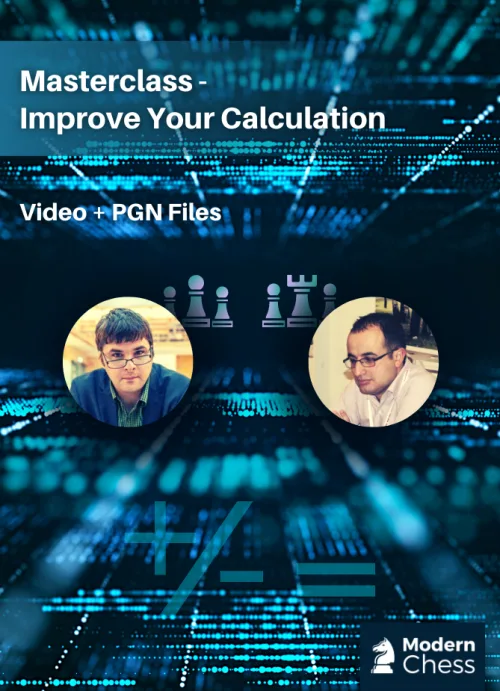
The Tactical Thursday camp on Typical Calculation Mistakes is now available as a digital product, offering a comprehensive and practical guide to improving your ability to calculate variations. This product includes all the video lectures from the camp, along with a PGN file that complements the training sessions. In total, you’ll receive 6 hours of instructional video and a PGN database featuring 81 carefully selected files.
The Tactical Thursday camp on Typical Calculation Mistakes is now available as a digital product, offering a comprehensive and practical guide to improving your ability to calculate variations. This product includes all the video lectures from the camp, along with a PGN file that complements the training sessions. In total, you’ll receive 6 hours of instructional video and a PGN database featuring 81 carefully selected files.
Let's take a look at how GM Davorin Kuljasevic introduces the course:
We should start our calculation in every position with the prophylactic question: What would my opponent play if I gave him a free move? This step is often overlooked, but it's crucial in understanding the position better. It helps us generate sensible candidate moves and avoid blunders.
In the 'Ply Theory,' we call this step '0 ply.' It's the preliminary step before you actually start calculating your first move ('1 ply'), the opponent's reply ('2 ply'), and further moves ('3 ply,' '4 ply,' etc.). Ply refers to half a move, as every full move consists of White's and Black's moves. This way, we ensure we pay proper attention to every step in the calculation process to reduce unnecessary calculation mistakes.
We start with 0 ply. You can simply ask yourself what Black would play if it were his move or play a random move like 21.h4 instead. When we do that, we realize that Black's strongest threat is 21...Re5, with a discovered attack on the rook, not 21...Rxa2. This will help us in the next stage.
Next, we look at 1 ply, the candidate moves for White:
Once we have our candidate moves, we start calculating lines, one by one, starting with 21.Qxa7.
We should pay particular attention to ply 2, the opponent's resources. The best question to ask is: Can I refute my move? You should be skeptical about your candidate move, even if you really like it. This will allow you to find the opponent's strong resources, such as 21...Re7 in the 21.Qxa7? line.
The structured calculation process, as we have seen above, includes:
The product features:
✅ 4 in-depth lectures breaking down typical calculation errors.
✅ 20 interactive test positions to reinforce your skills.
✅ PGN files with all examples and test positions.
✅ Video Version with expert explanations by GM Kuljasevic.
Master these key tactical concepts and take your calculation abilities to the next level!


Extra 5% off on 2 or more courses from this series in one order, on top of the quantity discount.