
79.00 EUR 63.20 EUR
The course examines Najdorf positions arising after same-side castling, focusing on the structural plans and typical ideas that determine the outcome once theory runs out. Rather than a repertoire, it addresses the slow, manoeuvring middlegames most players leave unprepared, covering who controls c5 and d5, when to open the centre, and how to time key pawn breaks.
⚔️ Your theory runs out somewhere around move fifteen. Both kings are castled short, the position goes quiet, nobody is attacking anybody – and this is exactly where Najdorf players lose games they had no reason to lose.
🎯 Same-side castling is the half of the Najdorf nobody prepares, because on the surface nothing is happening. It is also the half where the points quietly change hands – game after game, year after year, in positions whose players never understood what they wanted.
🎯 In few openings does theory matter as much as in the Najdorf, but theory is only half the job: sooner or later the forced moves stop and what is left is a position you either understand or you do not. Castled short, White is not coming for your king – he wants a slow, manoeuvring game, and everything turns on the typical plans: who gets b4 in first, who owns c5 and d5, when to open the centre and when to shut a flank for good.
📌 So this is not a repertoire – it is the structures and the plans that decide them. Nobody is throwing pawns at your king here, the risk is far lower, and the points go to whoever understands the position better. The tactics are still here, and the course is full of sacrifices, but they have to be prepared first.
♟ The most common structure of all, after the trade on d5. White is one move from b4 and a free hand on the queenside, so Black has to act now:
1.e4 c5 2.Nf3 d6 3.d4 cxd4 4.Nxd4 Nf6 5.Nc3 a6 6.Be2 e5 7.Nb3 Be7 8.0-0 0-0 9.Be3 Be6 10.Nd5 Nbd7 11.Qd3 Bxd5 12.exd5 Rc8 13.c4 a5 14.Kh1 Re8 15.Rad1 Bf8 16.Nd2 g6 17.b3 Bg7 18.a3 h5 19.f3 e4!
🔧 Look at what the move does, not at how the position was reached. The pawn goes – 20.fxe4 Nc5! 21.Bxc5 Rxc5 – and with it goes White's dark-squared bishop, the best piece he had in this structure. Short–Cheparinov, Wijk aan Zee 2008: Black chose the natural slow move instead, and the game was lost from there.
💥 The quiet structures hide real violence. Black has just given a whole piece:
1.e4 c5 2.Nf3 d6 3.d4 cxd4 4.Nxd4 Nf6 5.Nc3 a6 6.f4 e5 7.Nf3 Nbd7 8.a4 Qc7 9.a5 Nc5 10.Nd5 Nxd5 11.exd5 Be7 12.b4 Nd7 13.c4 b6! 14.axb6? Qxb6 15.Ra4 0-0 16.fxe5 dxe5 17.c5 Nxc5!
⚡ 18.bxc5 Bxc5 and the king that never left the centre has no shelter anywhere. The beauty of it is that it is not a trick: in this structure the sacrifice is simply what the position was asking for.
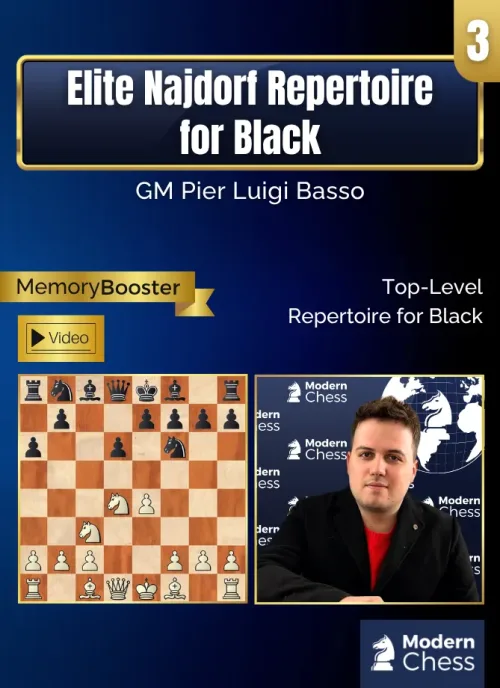
🧩 If you play the Najdorf yourself, the theory that leads to these positions is in the Elite Najdorf Repertoire for Black by GM Jose Martinez Alcantara and GM Pier Luigi Basso.
📚 Elite Najdorf Repertoire for Black - Part 1 covers 6.Bg5, 6.Bc4, 6.h3 and the English Attack with 6.Be3, Elite Najdorf Repertoire for Black - Part 2 covers the rest of the lines White can choose on move 6, and ...and Elite Najdorf Repertoire for Black - Part 3 brings both up to date with everything that changed in the year after their release
🔀 When White avoids the Najdorf altogether with 3.c3, 3.Bc4, 4.Qxd4, 5.f3, 5.Bd3 or 5.Bc4, the answers are in Fight the Anti-Najdorf Variations - Elite Repertoire for Black.
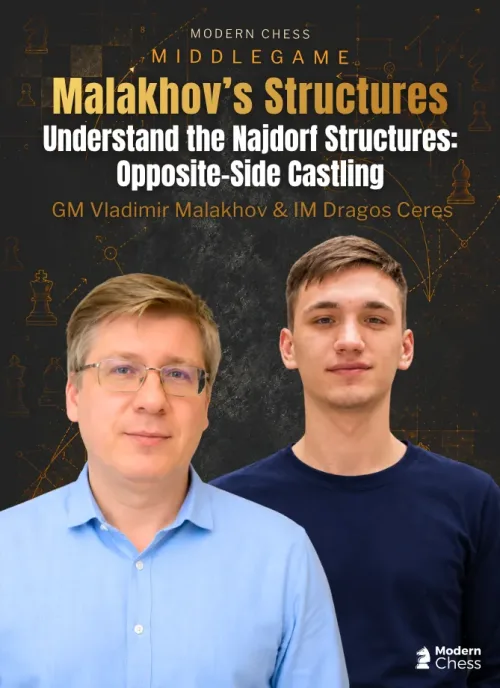
🔗 And when the kings go to opposite sides, the plans change completely – that race is the subject of Understand the Najdorf Structures - Part 2 - Opposite-Side Castling.
IM Dragos Ceres


Extra 5% off on 2 or more courses from this series in one order, on top of the quantity discount.