
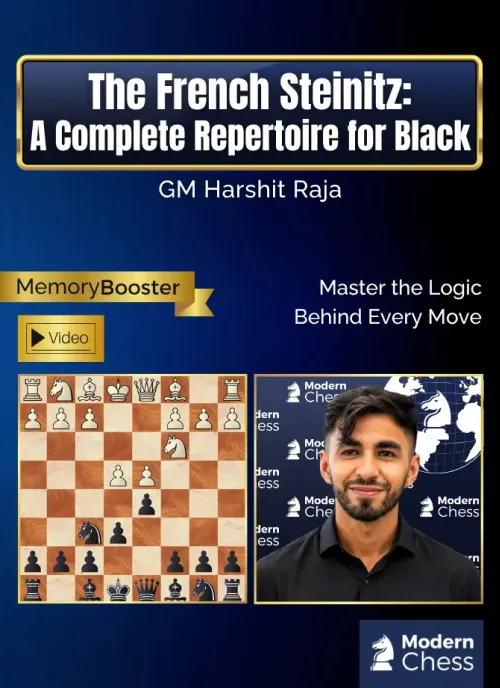
GM Harshit Raja's The French Steinitz: A Complete Repertoire for Black answers 3.Nc3 Nf6 with a practical, understanding-based approach: Black meets White's e5–f4 wedge with ...c5, ...Nc6, and the flexible ...a6 preparing ...b5, giving a consistent plan against all of White's setups. Covering 4.exd5, 4.Bg5, and the main 4.e5 lines across 10 chapters, it complements the author's sharper Winawer to give Black a genuine choice against 3.Nc3.
2h 14m PGN Available Memory Booster Interactive Tests
PGN Languages:


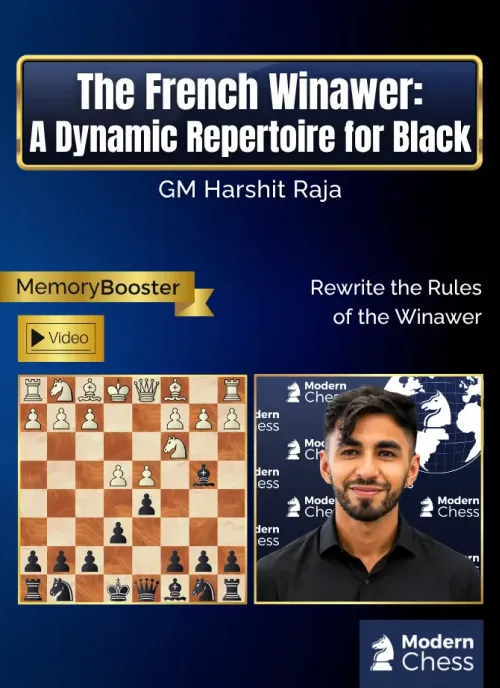
GM Harshit Raja's The French Winawer: A Dynamic Repertoire for Black builds a complete answer to 3.Nc3 Bb4 around the rare 6...Nc6!?—a Rapport-inspired idea that develops queenside pieces first and castles long, away from White's kingside attack. Across 10 chapters it covers all of White's serious setups, with 20 test positions, Memory Booster, video instruction, and multilingual PGNs, offering a sharp alternative to the author's Steinitz repertoire.
1h 36m PGN Available Memory Booster Interactive Tests
PGN Languages:
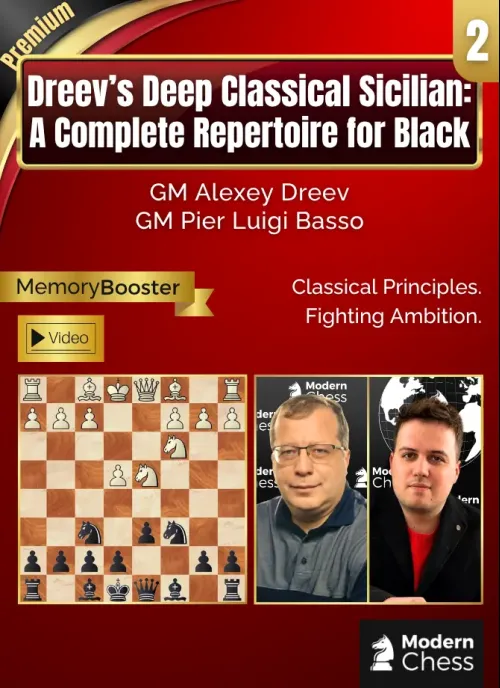
When Bobby Fischer and Dragoljub Velimirović wanted to fight the Classical Sicilian, they reached for 6.Bc4, the Sozin. The bishop aims straight at Black's kingside, and decades later it remains the most important alternative to 6.Bg5.
GM Alexey Dreev's answer is immediate. After 6...Qb6 7.Ndb5 he plays 7...Bg4!?, a move Vladimir Kramnik tried only once, back in 1996. It is rare, it is sound, and in Dreev's own words, your opponent will be surprised.
3h 54m PGN Available Memory Booster Interactive Tests Computer Practice
PGN Languages:
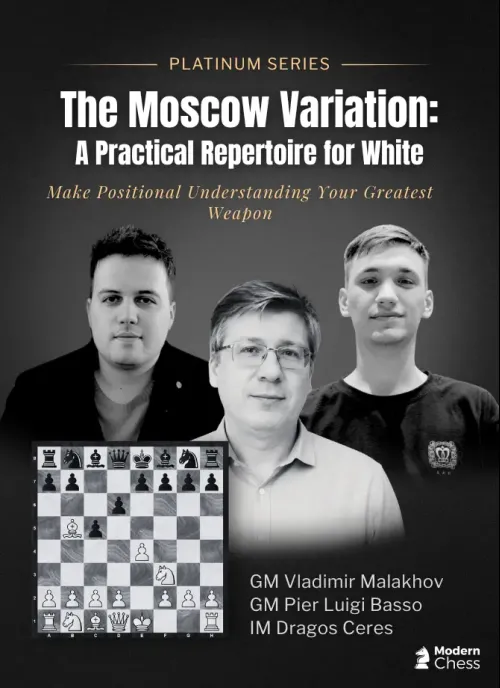
GM Malakhov, GM Basso, and IM Ceres present The Moscow Variation: A Practical 3.Bb5+ Repertoire Against the Sicilian, a practical anti-Sicilian answer to 2...d6 built around 3.Bb5+, avoiding heavy Najdorf, Dragon, and Classical theory. The repertoire emphasizes the Maroczy structure after 3...Bd7 4.Bxd7+ Qxd7 5.c4, with practical treatments of 3...Nd7, 3...Nc6, and other replies. As a Platinum Course, it offers 12 theory chapters, video instruction, 50 test positions, model games, a Memory File and Booster, To-Go versions, multilingual PGNs, and free updates every six months for two years, completing the authors' 3.Bb5 repertoire alongside Malakhov's Rossolimo volume.
5h 6m PGN Available Memory Booster Interactive Tests Computer Practice
PGN Languages:
GM Sina Movahed’s The Open Sicilian: A Complete Attacking Repertoire for White offers a practical, classical answer to the Open Sicilian, recommending lines like 6.Be2 against the Najdorf and 7.Bg5 in the Sveshnikov to keep the initiative while avoiding heavy modern theory. Covering all major Black replies, the 16-chapter course emphasizes clear plans and learnable positions, with premium features including test positions, video instruction, and multilingual PGNs.
3h 43m PGN Available Memory Booster Interactive Tests Computer Practice
PGN Languages:
In the 1980s, English club players gave a modest name to their favourite weapon against the Pirc. The "150 Attack" (named after a British grading of roughly 1800) needed no deep theory: Be3, Qd2, castle long, push the h-pawn. It was a plan any club player could follow.
Decades later, this simple scheme is still the main reason many players are afraid to play 1...d6. In Jobava's Pirc: A Dynamic Repertoire for Black – Part 2, GM Baadur Jobava answers it with one modest move: 4...a6!
2h 22m PGN Available Memory Booster Interactive Tests Computer Practice
PGN Languages:
Over the past few decades, the Advance Variation has become one of White's most flexible weapons against the Caro-Kann. After 1.e4 c6 2.d4 d5 3.e5, White usually gets to choose the character of the fight: a slow build-up with 4.Nf3, an aggressive 4.h4, a sharp 4.Nc3 with g4, or an early 4.g4.
The underlying idea of this course is simple and demanding: take that choice away. With 3...c5, Black strikes at the center at once and moves the game onto his own terms.
1h 48m PGN Available Memory Booster Interactive Tests
PGN Languages:
From intuition to system
Capablanca played the Caro-Kann by feel. Mikhail Botvinnik took the same opening, studied it, built it into a system, and carried it into World Championship matches. Without him, the Caro-Kann as it is played today would not exist.
That is the thread GM Pier Luigi Basso follows in the second part of his Caro-Kann Legacies series. He traces the modern opening back to Botvinnik, game by game.
3h 26m PGN Available Interactive Tests
PGN Languages:
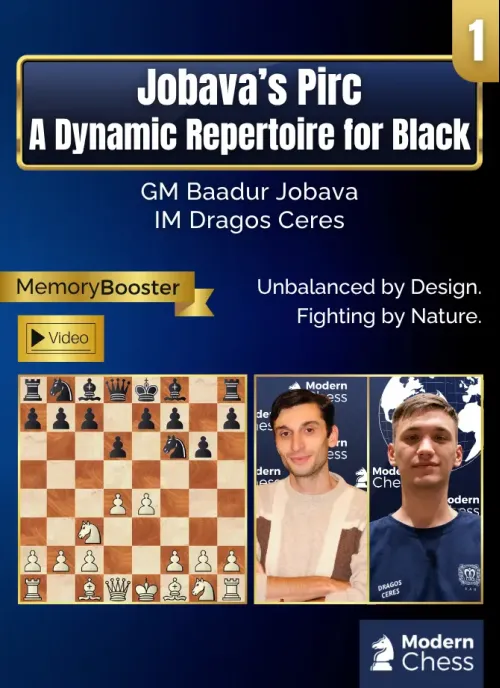
GM Baadur Jobava opens with a direct admission: he hates it when White decides the game is a draw at move ten. The Pirc is his answer — Black hands over the centre deliberately, lets White build it, and then takes it apart, so that every White plan carries a concrete price and there is no early simplification, no dead symmetry, and no forced route to a draw. Part 1 is anchored in the Austrian Attack across six chapters, with the Classical System, the Italian-style 4.Bc4 and the Fianchetto System completing it — and the author singles out the position after 7.O-O e5! as the most important chapter in the course.
3h 5m PGN Available Memory Booster Interactive Tests
PGN Languages:
The first volume of a new six-month project, and it begins where the French itself begins: the Advance Variation and the archetypal pawn chain of d4 and e5 against d5 and e6, from which almost every strategic idea in the opening can be traced — the ...c5 break at the base, the pressure on d4 with ...Qb6 and ...Nc6, and the long-standing question of the light-squared bishop. GM Grigor Grigorov devotes two full lectures to the structure itself before any concrete line, then turns to the closed positions after 6.a3 c4 and the sharp gambit lines after 6.Bd3 cxd4. Theory is kept intentionally light — the aim is to enter the middlegame knowing what you are playing for, not to memorise sequences.
6h PGN Available Interactive Tests