
49.00 EUR 36.80 EUR
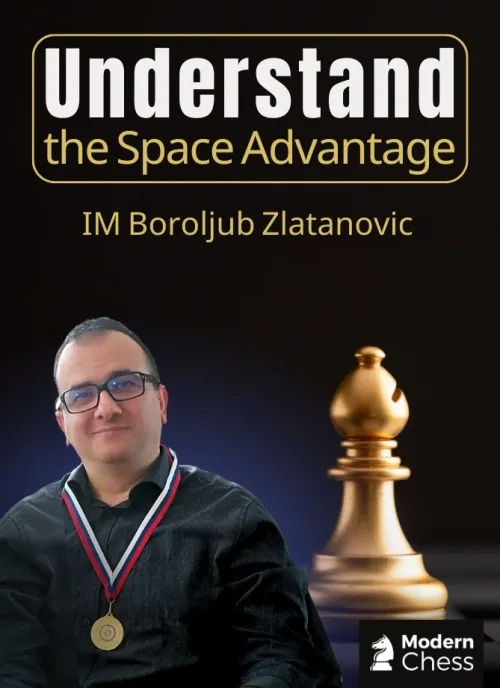
Positions with an isolated d-pawn are examined for both sides, with the pawn's owner playing for activity and the opponent trading toward an endgame. Attention falls on moments when this rule fails, including the ...Nxf2! resource, the timely pawn push, and attacks by pawns in front of the king.
⚔️ The isolated queen's pawn is the first structure a player learns and the last one he finishes understanding. The main rule is simple: the side with the pawn keeps pieces on and plays for activity, the side against it trades and plays for the endgame. It is a good rule – but the value of every move here is high, and the rule alone never tells you which move that is.
🎯 This course comes out on my birthday, and I wanted to mark the occasion with something special, so it is built around the places where that rule runs out. Alongside the famous games it spends its time on what is rarely shown: resources that look impossible, a defence that contradicts the principle everybody is taught, and attacks that fail only because they began one move too early.
📌 Six model games, from the 1908 World Championship to 2026. Two come from the same match, the same opening and almost the same position – one won by White, the other by Black, days apart.
♟ Begin with a resource most players never even look for. Black's knight sits on e4, White has just played Rc2, and the pawn on e3 turns out not to be defended at all:
...13.Bb2 Ne4 14.Rc1 Bg4 15.Rc2 Rac8 16.Qa1 Nxf2!
🔧 17.Rxf2 Bxe3 18.Qd1 d4! is overwhelming; only 17.Rxc5 Bxf3 18.Rc2! holds, and even then 18...Nh3+ 19.Kh1 Be4 20.Rd2 d4! leaves White to be careful. Geller–Spassky, 1965: here ...Nxf2 is not a trick but a move to check on every turn.
💥 The pawn's own moment. White has improved quietly for seventeen moves, and then pushes it:
...16.a3! Qc7? 17.Bg5! Qa5 18.d5!
⚡ 18...exd5 19.Bxf6 Bxf6 20.Bxh7+! Kxh7 21.Rxd5! – the rook hits the queen and Rh5+ is coming – and 21...Bxc3 22.Rxa5 Bxa5 23.b4! costs a piece. Kamsky–Karpov, World Championship 1996: the pawn is a weakness for forty moves and then wins the game in one.
🔍 And an idea that belongs in no textbook: the side with the isolated pawn attacking with the pawns in front of his own king.
...18.Be5 Bxa4! 19.Qxa4 Nc6! 20.Bf4? g5! 21.Bg3 h5!
🛡️ ...h4 is coming and the bishop has nowhere to go: 22.Nd4 Nxd4 23.exd4 h4 24.Be5 f6! 25.f3 fxe5 26.fxe4 exd4 and Black wins. Fischer–Spassky, World Championship 1972 – except that Spassky never played it. The dark-squared bishop is the piece that decides this structure, and it can be hunted down.
🎯 The Panov Attack, the Tarrasch, the Queen's Gambit, the Nimzo-Indian – sooner or later this structure appears on your board, and what decides those games is not the rule but the moments when it stops applying.
🧩 This course joins my series on pawn structures – among them Understand the Carlsbad Structure, Exchange Slav – Pawn Structure Guide and Understand the Najdorf Structures.
GM Vladimir Malakhov


Extra 5% off on 2 or more courses from this series in one order, on top of the quantity discount.