

The Queen's Gambit Declined has long been synonymous with solid, classical play—Black stabilizing with moves like 5...c6 or 5...Be7, aiming for gradual equality through patient maneuvering. But what if Black could retain the QGD's soundness while immediately fighting for dynamic counterplay? GM Alexander Riazantsev posed this question with 5...Bb4, a move that challenges the entire philosophy of the opening. Rather than slow equality, Black puts direct pressure on the c3-knight, transforming the character of the position. Magnus Carlsen has employed this setup at the highest level, and now GM Sina Movahed presents a complete repertoire built around this ambitious concept.
2h 51m PGN Available Memory Booster Interactive Tests
PGN Languages:


When Magnus Carlsen consistently employs an opening system, the chess world takes notice. The move 3...a6 in the Queen's Gambit Declined—a seemingly modest pawn push—has become Carlsen's strategic weapon against the Catalan, transforming what appears to be a minor sideline into a viable fighting system at the highest level. Now, GM Karthik Venkataraman brings this approach to Modern Chess with his debut course, offering a complete repertoire built around the move order 1.d4 Nf6 2.c4 e6 3.Nf3 a6.
3h 5m PGN Available Memory Booster Interactive Tests
PGN Languages:

Every tournament player knows the scenario: you're paired with Black against an opponent rated 150-200 points below you. The Slav leads to symmetrical positions where winning becomes an act of will rather than chess. The King's Indian demands encyclopedic preparation and nerves of steel. The Carlsbad structures are so solid they practically beg for a handshake on move 20.
GM Mahammad Muradli found himself facing this exact dilemma repeatedly—until he rediscovered 3...a6 in the Queen's Gambit Declined. What appears at first glance as a modest sideline conceals a provocative idea: Black immediately threatens ...dxc4, forcing White to make concrete decisions before settling into comfortable theoretical waters. But the real revelation comes on move five with the rare and underestimated 5...Be6, a move that transforms the entire system from a solid equalizer into a double-edged battlefield where Black dictates the character of the struggle.
2h 16m PGN Available Memory Booster Interactive Tests
PGN Languages:

The Nimzo-Indian Defense isn't just surviving in 2026—it's thriving at the highest level. When rising stars like Praggnanandhaa, Gukesh, and Erigaisi consistently reach for the same opening with Black, the message is clear: this isn't nostalgia for Botvinnik's era, but a living, breathing weapon that delivers results against the world's best preparation. GMs Szymon Gumularz and Pier Luigi Basso have decoded exactly why these elite players trust the Nimzo-Indian, and their new course reveals the engine-approved concepts driving this renaissance.
Sequence: Modern Nimzo-Indian Repertoire »
3h 45m PGN Available Memory Booster Interactive Tests
PGN Languages:

When Dreev and Basso concluded their previous two volumes on the Catalan, they left one critical junction unexplored—the moment after 4.g3 Bb4+, where Black's check forces White into a labyrinth of transpositions. This third installment confronts that complexity head-on, offering not just a repertoire but a conceptual framework for understanding why the same positions arise from wildly different move orders.
The leitmotif here is transposition as weapon rather than obstacle. Where many players see confusion in the multiple routes to similar structures, Dreev and Basso reveal a unifying logic: the early Bd2 creates a tempo advantage that subtly reshapes familiar Catalan positions. After 5.Bd2 Be7 6.Bg2 O-O 7.O-O, Black's responses split into distinct strategic families—and White's extra move proves useful in each.
Sequence: Catalan According to Dreev »
4h 25m PGN Available Memory Booster Interactive Tests
PGN Languages:

For decades, White players facing 1.d4 Nf6 2.c4 e6 have confronted a fundamental dilemma: enter the heavily analyzed main lines of the Nimzo-Indian or Queen's Indian, where preparation often matters more than understanding, or deviate into sidelines that promise little objective advantage. GM Mahammad Muradli offers a third path with his new course on 3.Bf4 – a move that transforms the character of the struggle without sacrificing White's opening advantage.
2h 27m PGN Available Memory Booster Interactive Tests
PGN Languages:

The Queen's Gambit Declined with 4...Nbd7 has become the contemporary player's fortress—Carlsen's choice when solidity matters, Aronian's trust in critical moments, Kramnik's classical foundation. It's the line you expect to face when serious opponents sit across from you. But what happens when the expected is met with 5.Qc2—not the fourth most popular move, not even the third, but a choice that sits quietly at fifth, carrying precision over popularity?
This is the philosophy behind 1.d4 According to Lucas Van Foreest - Fight the Queen's Gambit Declined - Part 2, the eighth installment in the 1.d4 According to Lucas series. GM Lucas Van Foreest and GM Pier Luigi Basso don't promise magic bullets—they offer something better: a repertoire engineered for practical discomfort where Black's preparation evaporates.
Sequence: 1.d4 According to Lucas van Foreest »
3h 23m PGN Available Memory Booster Interactive Tests
PGN Languages:
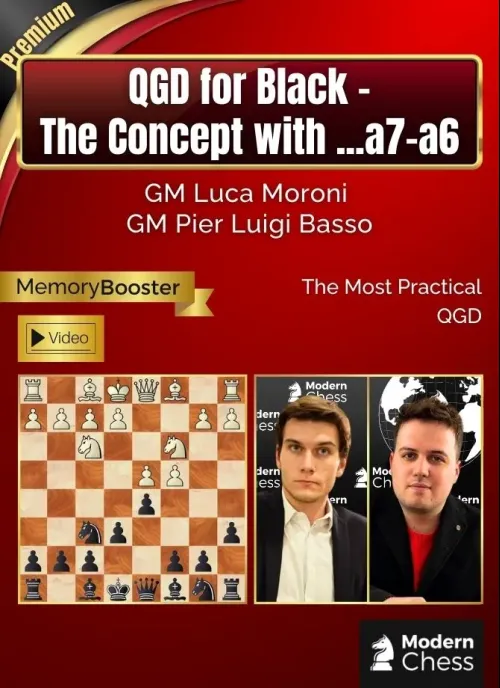
When GM Luca Moroni and GM Pier Luigi Basso set out to create a practical Queen’s Gambit Declined repertoire for Black, they deliberately avoided chasing short-lived novelties in heavily analyzed main lines. Instead, they returned to a more fundamental question:
What if understanding could replace memorization?
The answer is the modest yet profound move 4…a6 — a concept that transforms the Queen’s Gambit Declined into a lifetime weapon, built on clarity, structural consistency, and transferable plans rather than fragile theoretical details.
4h 10m PGN Available Memory Booster Interactive Tests Computer Practice
PGN Languages:

The Benko Gambit stands at a fascinating crossroads in contemporary chess. Long dismissed by super-GM practice as insufficiently ambitious after 5.e3, it has quietly evolved into something different—not a refuted opening, but a psychological weapon that challenges the very foundation of White's spatial advantage. IM Kushager Krishnater's new repertoire doesn't pretend otherwise. Instead, it embraces the Benko's modern reality: a system where Black trades the classical pawn sacrifice for immediate central confrontation with 5...e6, transforming positional compensation into dynamic equality.
3h 6m PGN Available Memory Booster Interactive Tests Computer Practice
PGN Languages:

When Baadur Jobava introduced 3.Bf4 followed by Nb5, he didn't just create an opening system—he planted a flag in uncharted territory. Now, as opponents scramble to neutralize this aggressive setup with recommendations like 3...a6 4.e3 b5 and 4...h6!?, the Georgian grandmaster returns with a direct challenge: Jobava Against the World. This 2025 Edition of Part 2 isn't merely an update—it's a statement that the Jobava London remains one step ahead of contemporary theory, backed by fresh ideas, real tournament victories, and the inspired success story of FM Francesco Bettalli's climb to the IM title.
6h 50m PGN Available Memory Booster Interactive Tests

