
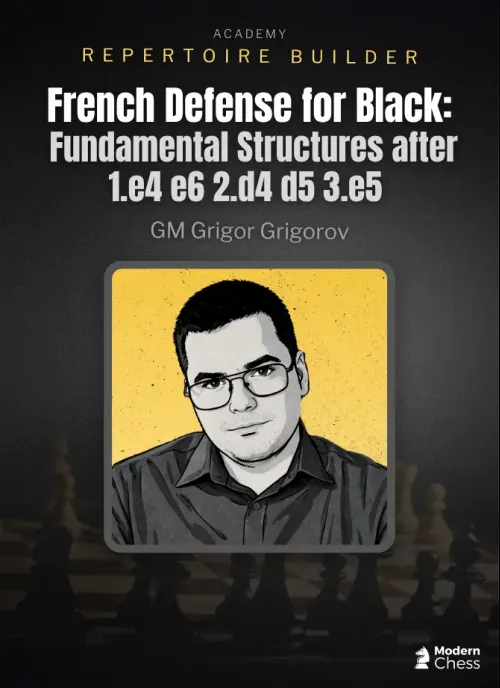
The first volume of a new six-month project, and it begins where the French itself begins: the Advance Variation and the archetypal pawn chain of d4 and e5 against d5 and e6, from which almost every strategic idea in the opening can be traced — the ...c5 break at the base, the pressure on d4 with ...Qb6 and ...Nc6, and the long-standing question of the light-squared bishop. GM Grigor Grigorov devotes two full lectures to the structure itself before any concrete line, then turns to the closed positions after 6.a3 c4 and the sharp gambit lines after 6.Bd3 cxd4. Theory is kept intentionally light — the aim is to enter the middlegame knowing what you are playing for, not to memorise sequences.
6h PGN Available Interactive Tests
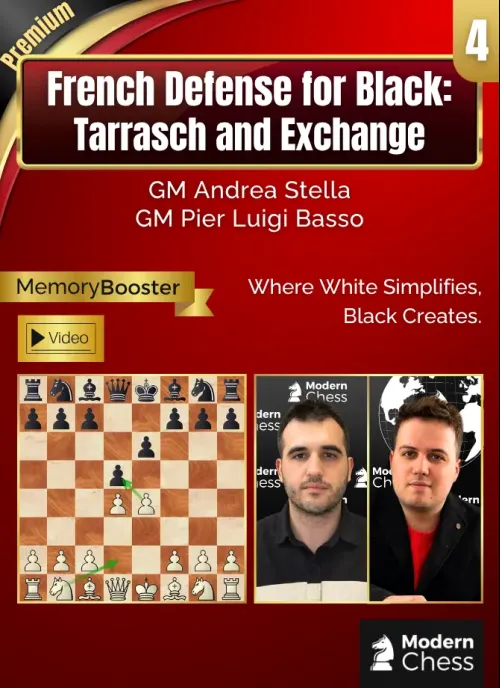
Every French player knows the moment. You brace for the theoretical fights of 3.Nc3, and instead White slides the knight to d2 or simply trades on d5. These are not attempts to refute your opening — they are attempts to drain it of life. The Tarrasch and the Exchange are the practical player's tools: low theory, low risk, and built on the quiet hope that Black will grow bored, passive, or both.
GM Andrea Stella and GM Pier Luigi Basso built this fourth and final part to reject that bargain. Their repertoire takes the two lines French players meet quite often and reframes them as positions Black plays for a win — not through wild complications, but through a chain of deliberate second choices that keep tension exactly where the mainlines offer symmetry.
5h 55m PGN Available Memory Booster Interactive Tests Computer Practice
PGN Languages:


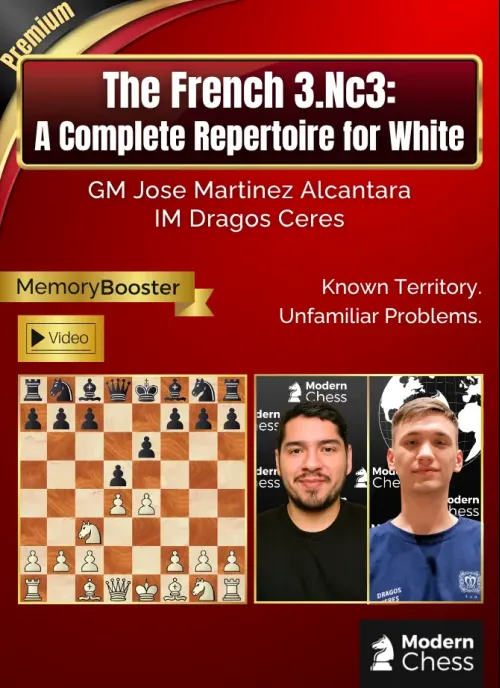
For a hundred years, the French has been the opening where the defender knows the ground better than the attacker. The Winawer and the Steinitz have been mapped move by move for generations, and the French specialist arrives at the board expecting White to be the first to run out of memory. The French 3.Nc3: A Complete Repertoire for White was built to reverse that expectation.
The method is not to out-analyse a century of theory but to step around it. In every principal line the repertoire turns toward positions with a few hundred games in the database rather than tens of thousands — places where understanding the plan matters more than recalling the next fifteen moves, and where Black is left to think independently remarkably early.
4h 7m PGN Available Memory Booster Interactive Tests Computer Practice
PGN Languages:
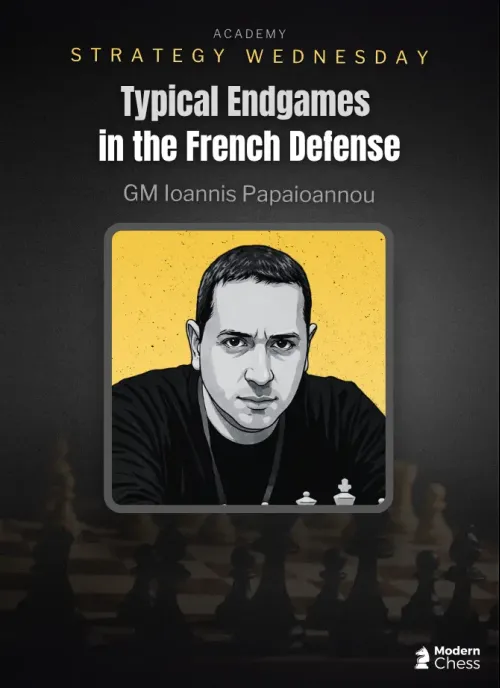
More than almost any other opening, the French is defined by its endgames — the middlegames flow again and again into the same recurring family of positions, and the player who understands them holds a lasting edge over the one who merely reaches them. Across four lectures, GM Ioannis Papaioannou covers the typical endings of the Advance, Tarrasch, Winawer and Exchange variations: the isolated-pawn structures and the critical light-squared bishop trade, the d4/e5 pawn chain, and the doubled c-pawns of the Winawer and MacCutcheon.
6h PGN Available Interactive Tests

The French Defence has always carried one complaint louder than the rest: the light-squared bishop on c8, sealed behind its own pawns before the game has properly begun. The Fort Knox answers that complaint before it can be made. After 1.e4 e6 2.d4 d5 3.Nc3 dxe4 4.Nxe4 Bd7, Black's problematic piece steps out through d7 to c6 while the diagonal is open — the piece that usually spends the game being restricted becomes the first one developed.
The idea is simple and durable. The bishop on c6 is no longer a liability but a piece which will be traded — Black is content to give it up for a white knight, often with ...Bxe4, easing the cramped position. Black finishes developing with ...Nd7, ...Ngf6, ...Be7 and short castling, reaching a compact structure with no real weaknesses to attack, and only then looks to challenge White's centre with ...c5 or, in some lines, ...e5.
1h 48m PGN Available Memory Booster Interactive Tests Computer Practice
PGN Languages:

Ask a well-prepared opponent how they meet the Advance today, and you'll hear a dozen fashionable answers: an early ...Qc7, ...Bd7–b5 maneuvers, ...Nge7 setups designed to sidestep theory. GM Andrea Stella takes a different road. In French Defense for Black – Part 3, he goes back to what he calls the "good and old mainline" — 5...Qb6, 6...c4, 7...Na5 — the classical treatment of White's most ambitious try against the French.
The choice is deliberate. Stella recommends 5...Qb6 not because it hides from theory, but to keep the "classical spirit": pressure on d4 and b2 from move five, a healthy structure, and a plan Black actually wants to play. The result is presented as a sound, fighting repertoire against 3.e5 rather than a survival guide.
4h 37m PGN Available Memory Booster Interactive Tests Computer Practice
PGN Languages:

For most of its history, 1.e4 e6 2.d4 d5 3.Nc3 has been White's most challenging option against the French. It's the most common move here, and against 3...Nf6 it opens the door to the Steinitz Variation with 4.e5. In Creative French Repertoire for Black – Part 2, GM Renato Quintiliano and GM Yago Santiago don't play it safe for equality — they hand White a problem the engine tends to underrate.
The idea that sums up the course comes deep in the main line: 4.e5 Nfd7 5.f4 c5 6.Nf3 Nc6 7.Be3 Qb6 8.Na4 Qa5+ 9.c3 b6 10.Bd2 c4 11.b4 Nxb4! 12.cxb4 Bxb4 — two pawns and a three-to-one pawn majority on the queenside for the piece. The engine says White is better, and the authors don't dispute it. But that's not the whole story at the board: White's pieces stay tangled, the extra piece is hard to bring into play, and the defender has to solve real problems on every move.
6h 37m PGN Available Memory Booster Interactive Tests
PGN Languages:

The French Defense has experienced a dramatic renaissance. From club tournaments to elite events, 1...e6 is back—sharper, more resilient, and better prepared than ever. White's response needs to be equally uncompromising.
GM Jose Martinez Alcantara and GM Pier Luigi Basso present the Advance Variation not as one approach among many, but as White's most forcing, most ambitious weapon against the French. With 3.e5, White seizes massive central space, restricts Black's position before coordination is achieved, and launches concrete attacking plans that demand precision from move one.
4h 27m PGN Available Memory Booster Interactive Tests Computer Practice
PGN Languages:

With 4.Bg5, White tries to change the subject. Rather than the direct 4.e5 that Part 1 was built to answer, the bishop develops and invites the French player onto different ground. Stella's reply, 4...Be7, quietly declines the argument — after 5.e5 the game folds straight back into the Steinitz pawn chain the whole repertoire is built around. The move meant to sidestep the Steinitz becomes another road into it.
5h 14m PGN Available Memory Booster Interactive Tests
PGN Languages:

For most of the Steinitz's history, 5.f4 was the main move. It was where White claimed the most space, and where every French player braced for the main fight. That has quietly changed. Modern theory has worked the 5.f4 lines out so concretely that White struggles to prove anything real — and a second front has opened at 5.Nce2, the positional try where understanding matters more than memory. Part 1 of GM Andrea Stella's Steinitz answers both, and treats them as two different problems needing two different kinds of preparation.
7h 27m PGN Available Memory Booster Interactive Tests
PGN Languages: