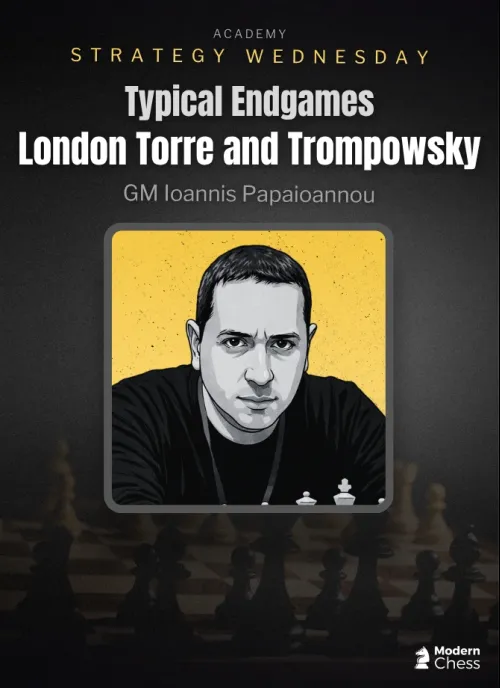
GM Ioannis Papaioannou · Oct 27, 2026
This course examines the endgames arising from three related White systems — the London System, the Torre Attack, and the Trompowsky — which share a common structural logic: the early commitment of the queen's bishop and the recurring pawn formations, most often Carlsbad structures, that follow. The course addresses how dark-square strategy carries into the endgame and how small but durable structural advantages are converted through precise technique and accurate piece placement.
6h
PGN Interactive Tests

FM Sebastian Reimann GM Baadur Jobava GM Jan Subelj GM Jose Martinez Alcantara GM Lorenzo Lodici GM Tomas Sosa IM Ajay Santhosh+6 more · Sep 1, 2026
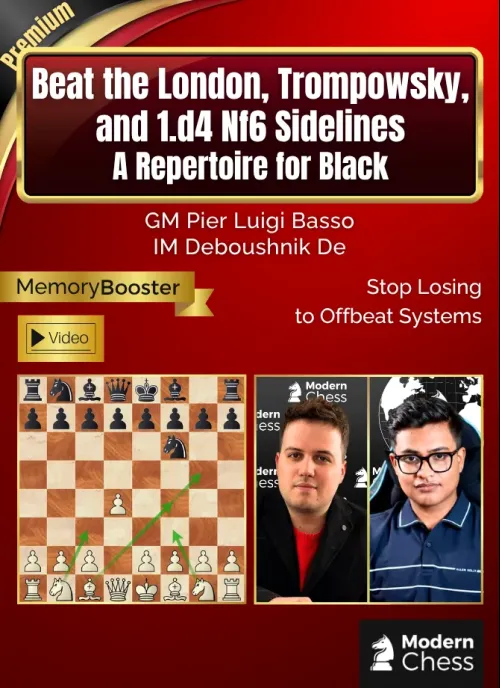
There is no shortage of repertoires against the London System. What there has never been is seven of them, side by side, produced independently by strong players who did not know what the others were writing.
That is what the Modern Chess Autumn Challenge produces, and this database is the result of its first stage. Each of the seven participants was handed the same two problems — a repertoire for Black against the Classical London (1.d4 d5 2.Nf3 Nf6 3.Bf4) and against the Jobava London (1.d4 d5 2.Nc3 Nf6 3.Bf4) — and each solved them their own way.
Fourteen recommendations. No two alike.


GM Ioannis Papaioannou · Jun 21, 2026
The London System without the memorisation: GM Ioannis Papaioannou presents a practical, low-theory repertoire for White built on understanding the structures rather than recalling forced lines. Organised by Black's setup and taught through model games from elite practice — Carlsen, Ding Liren, Giri, Aronian and others — it gives club players a complete, ready-to-play weapon and stronger players a reliable, time-efficient addition to their 1.d4 arsenal.
4h
PGN

GM Ivan Cheparinov · May 6, 2026
For decades, the London System carried a dual reputation. Strong players employed it as a reliable universal weapon, while critics dismissed it as a toothless option. GM Ivan Cheparinov's new course challenges this perception entirely.
His London isn't about avoiding preparation—it's about controlling the narrative. Where traditional London theory offers White a safe harbor, Cheparinov presents something more refined: a repertoire built on concrete plans rather than generic setups. Each of Black's defensive structures receives a tailored response, and what emerges is a system where White's flexibility becomes a weapon rather than a compromise.
5h 6m
PGN
Memory Booster
Interactive Tests


 Memory Booster
Interactive Tests
Computer Practice


