

The move is ...a6, and it has followed him for decades — first in the Chebanenko Slav, where 4...a6 became his signature, and then one move later, in the quiet lines where White declines to force anything at all. In The Slow Slav for Black – Strategic Foundations, Malakhov explains what that pawn is actually doing, and what kind of middlegame it produces.
Sequence: Malakhov's Slav Defense »
2h 54m PGN Available Interactive Tests
PGN Languages:


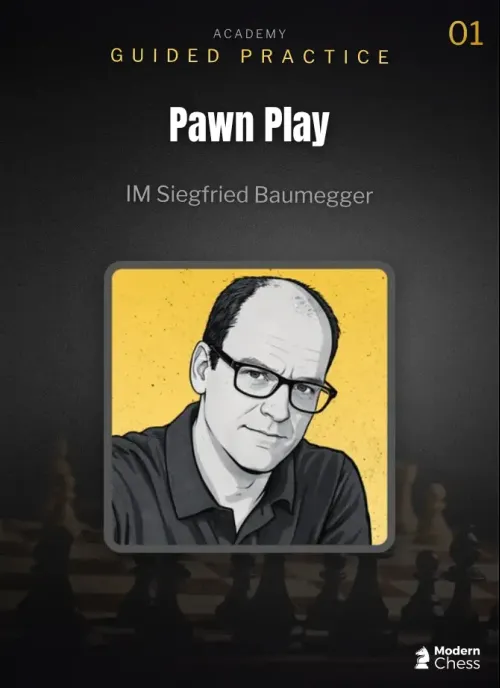
Every pawn move is permanent — it can never be taken back — which makes pawn play the most consequential decision-making in chess, the element Philidor called "the soul of the game." In this Guided Practice course, IM Siegfried Baumegger trains it in full: creating dynamic chances with your own pawns (space, open lines, a mobile majority, files for the rooks), attacking the opponent's pawn formation, restricting it so he never gets his own breaks, and handling the pawn decisions that settle endgames. Across exercises and annotated games from the players who understood pawns best — Petrosian, Kasparov, Polugaevsky, Gelfand and more — it turns pawn moves from instinct into purpose, so you shape the game on your terms.
2h PGN Available Interactive Tests

Games are rarely lost because a player failed to find something brilliant — they are lost to the same ordinary errors, made again and again: the line cut off one move too early, the reply that was never considered, the opponent's resource that arrived unseen. In this Guided Practice course, IM Siegfried Baumegger shows exactly where calculation breaks down and trains the discipline that prevents it: calculate until the opponent has no active moves left, take his best replies seriously, and watch constantly for his tactics. Across demanding exercises with guiding questions and annotated games from sharp calculators like Anand, Tal and Shirov, it rebuilds the thinking process from the inside — so the mistakes that quietly decide games stop appearing in yours.
2h 2m PGN Available Interactive Tests

You cannot choose a good plan until you have honestly judged the position — and a plan built on a faulty evaluation is worse than none at all. In this Guided Practice course, IM Siegfried Baumegger trains the skill beneath all the others: weighing the position against the factors that matter (king safety, material, the centre, piece activity, pawn structure, space and the initiative), filtering the essential from the incidental, and turning that judgement into the right plan. Across exercises and annotated games from great positional planners like Karpov, Geller and Carlsen, it also teaches the crucial distinction between static factors that endure and dynamic ones that must be used before they fade.
2h 7m PGN Available Interactive Tests

he King's Indian rests on a bargain. Black hands over the centre and the space, pushes ...e5, and after White closes the position with d5, Black receives in exchange the one thing that makes the whole opening worth playing: the kingside attack. The pawn break with f5 and a potential pawn storm, rook lift, and a potentially devastating attack.
The Makogonov System cancels that bargain. After 1.d4 Nf6 2.c4 g6 3.Nc3 Bg7 4.e4 d6 5.h3, White plays the quietest move on the board — and it turns out to be the first move of the most aggressive plan available. The pawn on h3 takes ...Ng4 and ...Bg4 away, which allows Be3 without harassment, and it prepares g2-g4. The break Black has been counting on since move one now costs far more to arrange, and it is White who takes the kingside first.
2h 37m PGN Available Memory Booster Interactive Tests
PGN Languages:

For decades, the Italian Game has been an awkward place to be as Black. The quiet maneuvering plans and the many move orders leave plenty of room to drift, and it is easy to end up passively placed with no clear idea. Movahed's answer sidesteps the heavily analyzed main lines that follow 4...Nf6. After 3...Bc5 he meets 4.c3 with the flexible 4...d6, lets White build the center with d4, and only then drops the bishop back to b6 — giving up a pawn to seize the initiative before White can consolidate.
2h 20m PGN Available Memory Booster Interactive Tests
PGN Languages:

The Ruy Lopez is usually White's kind of fight. After 1.e4 e5 2.Nf3 Nc6 3.Bb5, the familiar roads lead to slow, deeply mapped positions where White keeps the tension and sets the pace, while Black spends the middlegame answering questions rather than asking them.
The modest-looking 3...g6 changes that on move three. Black declares the character of the game at once: fianchetto the bishop, aim it down the long diagonal at White's centre, and head for an unbalanced struggle where the full point is a genuine target for both sides. As Pier Luigi Basso frames it in the introduction, this is a way to fight the Spanish and play for a complicated game — not to equalise quietly, but to reach positions with rich play for either side.
2h 30m PGN Available Memory Booster Interactive Tests
PGN Languages:

Every training app on the market feeds players a stream of positions in which something is there: a sacrifice, a deflection, a hidden fork. Solve enough of them and you begin to expect the board to reward searching. Over the board, though, most positions hold nothing of the kind — and the search itself becomes the mistake. IM Boroljub Zlatanovic builds Mastering Static Play on precisely that gap between how players train and what they actually face.
Sometimes one side, or both, cannot find an active plan. Very often the reason is simply that no such plan exists. What remains is the quieter work: improving the position where it needs improving — centralizing, maneuvering, exchanging, fixing weak spots — and waiting until a dynamic continuation becomes available.
3h 40m PGN Available Interactive Tests
PGN Languages:

Modern preparation is very good at getting you to a better position. It is much less good at telling you what to do once you are there. This is the gap IM Boroljub Zlatanovic addresses in Mastering Dynamic Play: the player who holds an advantage is obliged to play actively, because the moment activity stops, the advantage begins to drain away — and with it, the psychological edge passes to the opponent. Every single pause, as the author puts it, risks becoming a transition into defense.
That is the leitmotif of the course. Not "attack" as a mood, but active play as a duty that comes attached to a better position. Sustaining it is rarely comfortable: the opponent has resources, the initiative demands accuracy, and there is always a quieter move available. The course is built around recognizing what the position requires and then finding a realistic, promising way to keep pressing.
3h 56m PGN Available Interactive Tests
PGN Languages:

When White meets the Slav with 4.e3, the point is not to win a theoretical debate. It is to avoid one. The bishop goes to d3, the tension stays low, and White keeps a small, nagging pull without ever taking a risk — the kind of quiet setup that wears down opponents from the club hall to the elite. Black's difficulty here has never been finding a playable move. It has been finding one that does not slowly drift into a slightly worse, slightly passive game.
This repertoire answers with flexibility rather than memorization. The first decision sets the tone: 4...Bf5, developing the light-squared bishop outside the pawn chain before committing to ...e6. That single move drains much of the venom from White's systems, because the piece the Slav so often has to bury behind ...e6 is already out and working.
Sequence: Malakhov's Slav Defense »
2h 54m PGN Available Memory Booster Interactive Tests
PGN Languages: