


The 3.f3 System: Strategic Simplicity Against the Grünfeld and King's Indian
When top players like Anand began employing 3.f3 against the Grünfeld and King's Indian, they weren't searching for a tactical refutation. They were reclaiming White's most fundamental asset: the ability to establish a classical pawn center without committing to a rigid piece configuration. This flexible approach, systematically explored by IM Kushager Krishnater, offers White a coherent repertoire where strategic clarity replaces the encyclopedic memorization demanded by mainline theory.
A Repertoire Built on Flexibility
Krishnater's course addresses the core frustration many 1.d4 players face: the Grünfeld's analyzed-to-a-draw reputation and the King's Indian's labyrinthine complexity. By playing 3.f3, White secures e2-e4 while preserving different options—the b1-knight can develop to c3 or remain flexible for Nd2, depending on Black's setup. This structural ambiguity forces opponents away from their prepared lines and into positions where understanding trumps memorization.
The repertoire's scope is comprehensive. Against the Grünfeld mainline (3...d5), Krishnater presents the modern treatment with 6.Nc3 Bg7 7.Be3, while for the King's Indian structures, he examines both the immediate ...c5 break and the more restrained ...d6/...e5 setups, always emphasizing the practical advantages White obtains through central control and piece coordination. Krishnater also addresses Black's attempts to sidestep theory entirely—moves like 3...c6, 3...e5, and 3...Nh5—demonstrating how White's solid center punishes such deviations.
This course builds naturally on Krishnater's previous work in The Unexplored 1.d4 Nf6 2.c4 e6 3.Bg5. While that repertoire tackled 2...e6 systems, the current course handles 2...g6, giving players a cohesive answer to Black's two most popular responses after 2.c4.
Variation Map
The course structure follows Black's logical alternatives:
After 1.d4 Nf6 2.c4 g6 3.f3:
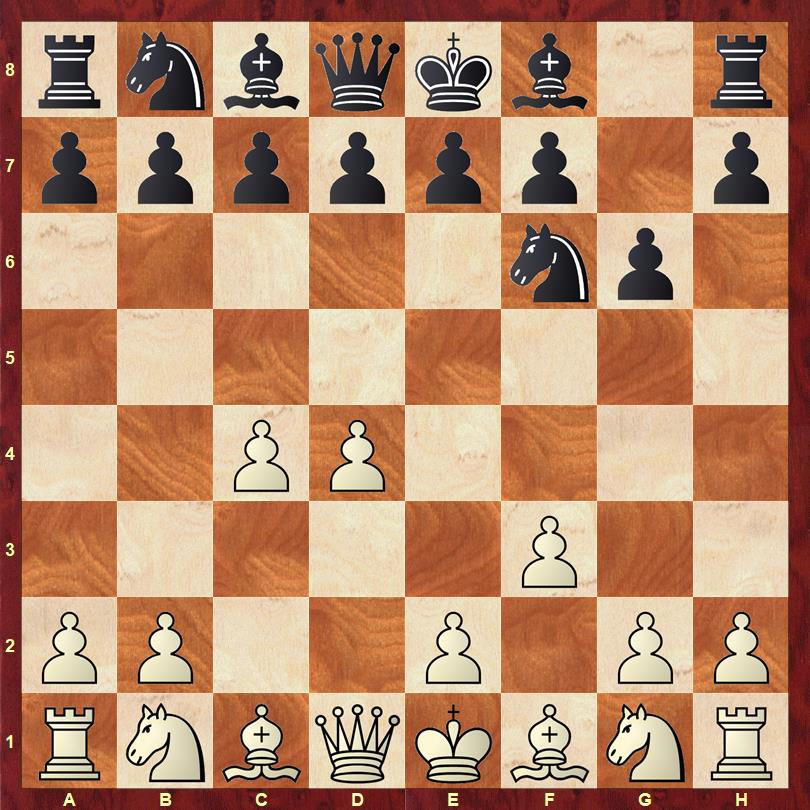
- Chapter 1 — 3...c6 / 3...e5 / 3...Nh5 (early deviations)
- Chapter 2 — 3...e6 (preparing ...d5 and ...c5 counterplay)
- Chapter 3 — 3...Nc6 (immediate central challenge)
- Chapter 4 — 3...c5 4.d5 d6 5.e4 Bg7 6.Ne2 e6 (Attacking white’s center)
- Chapter 5 — 3...c5 4.d5 d6 5.e4 Bg7 6.Ne2 O-O (Important line)
- Chapter 6 — 3...Bg7 4.e4 d6 5.Be3 O-O 6.Ne2 Nc6 / 6...b6 / 5...e5 (King's Indian alternatives)
- Chapter 7 — 3...Bg7 4.e4 d6 5.Be3 O-O 6.Ne2 c5 (main King's Indian, rare continuation)
- Chapter 8 — 3...d5 4.cxd5 Nxd5 5.e4 Nb6 6.Nc3 Bg7 7.Be3 Nc6 (Dubov's sharp try)
- Chapter 9 — 3...d5 main line with 8...e5 (risky continuation)
- Chapter 10 — 3...d5 main line with 9...f5 (Carlsen's dynamic move)
- Chapter 11 — 3...d5 main line with 9...Qd6 (absolute mainline with ...Rd8 pressure)
Course Features
- 11 Chapters
- 20 test positions
- Memory Booster
- To Go Version of every chapter
- Video instruction
- Multilingual PGN availability (English, German, French, Spanish)
Why to Study This Repertoire
Whether you're seeking refuge from the theoretical arms race in established Grünfeld lines or simply want a practical weapon that emphasizes strategic understanding over pure memorization, Krishnater's 3.f3 repertoire delivers. The system's flexibility and strategic coherence make it particularly valuable for players who prefer positions where classical principles guide decision-making.
Explore the full course and begin building a reliable repertoire against two of Black's most challenging defenses.