
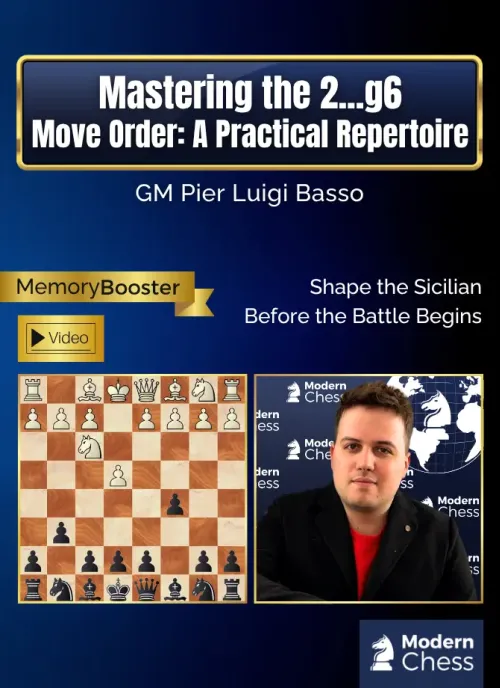
GM Pier Luigi Basso's Mastering the 2...g6 Move Order offers a practical Accelerated Dragon repertoire after 1.e4 c5 2.Nf3 g6, avoiding several annoying lines that arise after 2...Nc6. It covers every Anti-Sicilian White can try—including the critical Alapin (met by 3...d5!), 4.Qxd4 lines, and 3.Bc4—and pairs with Basso's Open Sicilian course for a complete repertoire after 2.Nf3. Includes 10 chapters, video instruction, model games, test/training positions, a memory booster, and multilingual PGN.
2h 7m PGN Available Memory Booster Interactive Tests Computer Practice
PGN Languages:


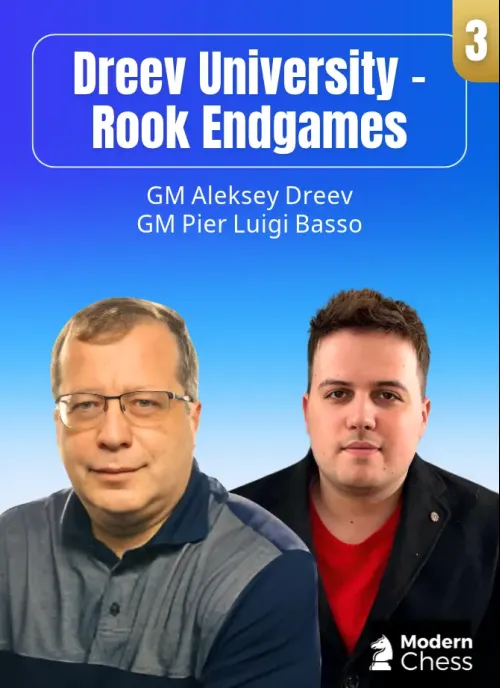
Dreev University – Rook Endgames Part 3 by GMs Alexey Dreev and Pier Luigi Basso teaches players to recognize the critical decision in rook endgames. Its 38 positions build through three stages: 20 positions around five fundamental questions, 8 mixed positions without guidance, and Dreev's Challenge—10 positions analyzed by Dreev, including recent Olympiad examples. The aim is instinct-building, not memorization.
1h 31m PGN Available
PGN Languages:
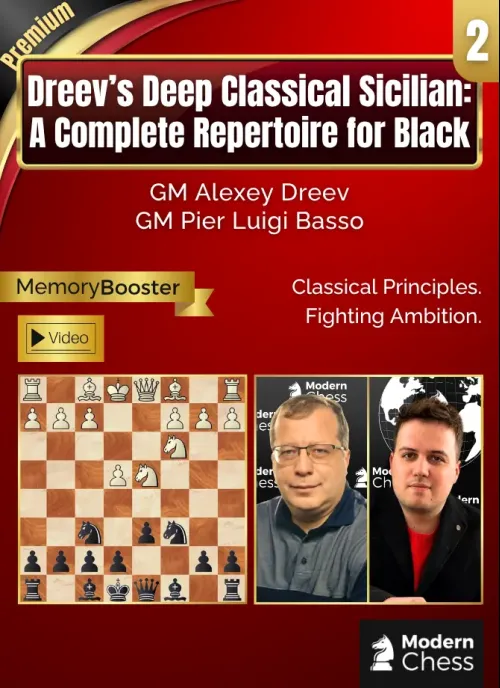
When Bobby Fischer and Dragoljub Velimirović wanted to fight the Classical Sicilian, they reached for 6.Bc4, the Sozin. The bishop aims straight at Black's kingside, and decades later it remains the most important alternative to 6.Bg5.
GM Alexey Dreev's answer is immediate. After 6...Qb6 7.Ndb5 he plays 7...Bg4!?, a move Vladimir Kramnik tried only once, back in 1996. It is rare, it is sound, and in Dreev's own words, your opponent will be surprised.
3h 54m PGN Available Memory Booster Interactive Tests Computer Practice
PGN Languages:
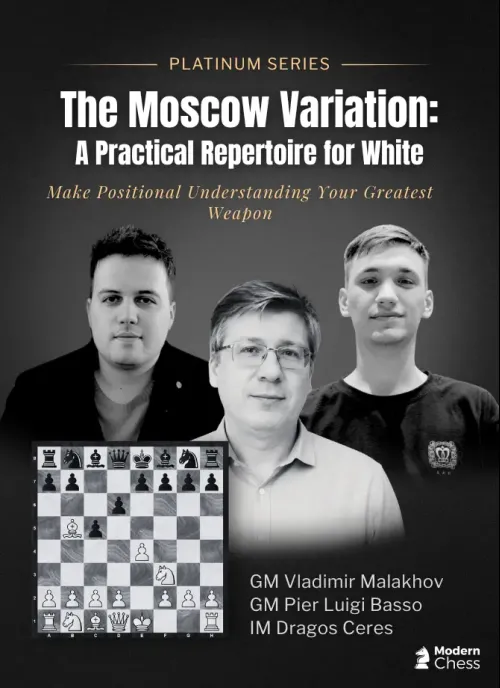
GM Malakhov, GM Basso, and IM Ceres present The Moscow Variation: A Practical 3.Bb5+ Repertoire Against the Sicilian, a practical anti-Sicilian answer to 2...d6 built around 3.Bb5+, avoiding heavy Najdorf, Dragon, and Classical theory. The repertoire emphasizes the Maroczy structure after 3...Bd7 4.Bxd7+ Qxd7 5.c4, with practical treatments of 3...Nd7, 3...Nc6, and other replies. As a Platinum Course, it offers 12 theory chapters, video instruction, 50 test positions, model games, a Memory File and Booster, To-Go versions, multilingual PGNs, and free updates every six months for two years, completing the authors' 3.Bb5 repertoire alongside Malakhov's Rossolimo volume.
5h 6m PGN Available Memory Booster Interactive Tests Computer Practice
PGN Languages:
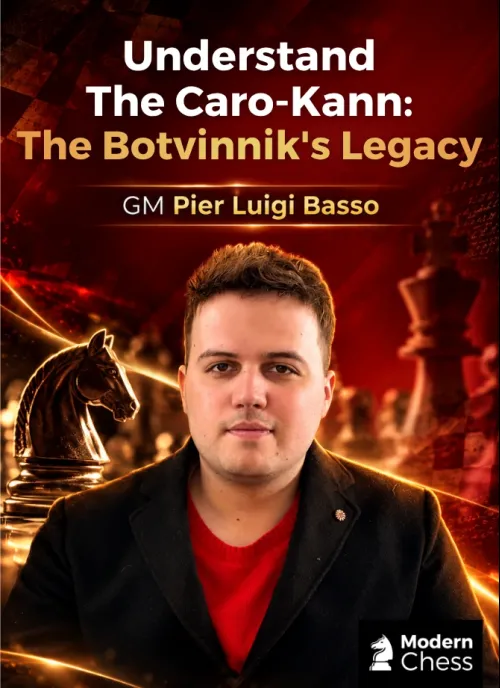
From intuition to system
Capablanca played the Caro-Kann by feel. Mikhail Botvinnik took the same opening, studied it, built it into a system, and carried it into World Championship matches. Without him, the Caro-Kann as it is played today would not exist.
That is the thread GM Pier Luigi Basso follows in the second part of his Caro-Kann Legacies series. He traces the modern opening back to Botvinnik, game by game.
3h 26m PGN Available Interactive Tests
PGN Languages:
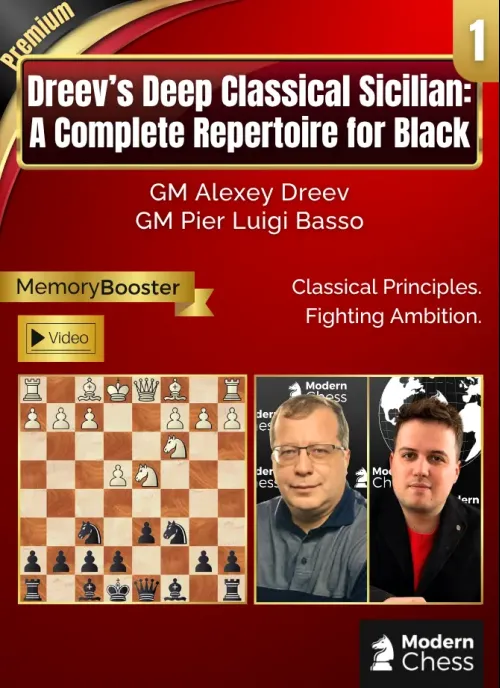
For GM Alexey Dreev, the Sicilian has never been a phase but a lifelong choice. He has played 1...c5 throughout his career, and among all its branches he considers the Classical Variation the most healthy one.
His reasoning is simple. Black develops naturally, fights for the centre and plays for a win, without the volume of forced theory that surrounds the Najdorf. What the Classical demands instead is understanding.
The Rauzer: There Is No Way Around It
Anyone who plays 1.e4 c5 2.Nf3 d6 3.d4 cxd4 4.Nxd4 Nf6 5.Nc3 Nc6 knows which move comes next most often: 6.Bg5, the Richter-Rauzer Attack. As Dreev puts it, a Classical Sicilian player will meet it in every second game.
That is why Part 1 of this repertoire is devoted entirely to 6.Bg5. Black answers with 6...e6, the classical main line. It requires real knowledge, but it gives a repertoire built to last, one that can be played against any opponent.
5h 5m PGN Available Memory Booster Interactive Tests Computer Practice
PGN Languages:
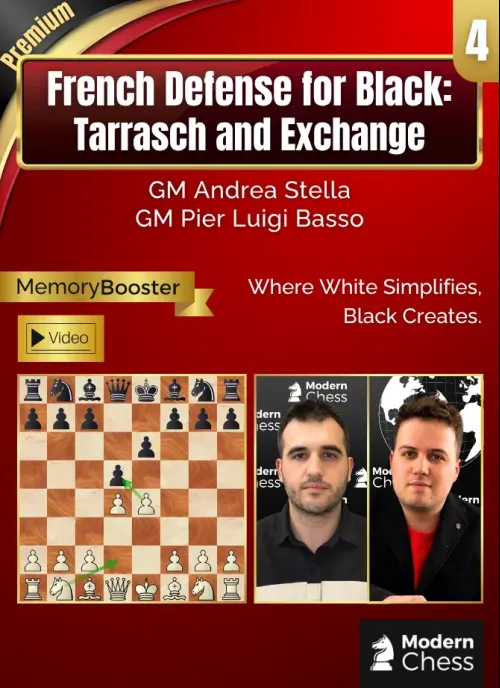
Every French player knows the moment. You brace for the theoretical fights of 3.Nc3, and instead White slides the knight to d2 or simply trades on d5. These are not attempts to refute your opening — they are attempts to drain it of life. The Tarrasch and the Exchange are the practical player's tools: low theory, low risk, and built on the quiet hope that Black will grow bored, passive, or both.
GM Andrea Stella and GM Pier Luigi Basso built this fourth and final part to reject that bargain. Their repertoire takes the two lines French players meet quite often and reframes them as positions Black plays for a win — not through wild complications, but through a chain of deliberate second choices that keep tension exactly where the mainlines offer symmetry.
5h 55m PGN Available Memory Booster Interactive Tests Computer Practice
PGN Languages:
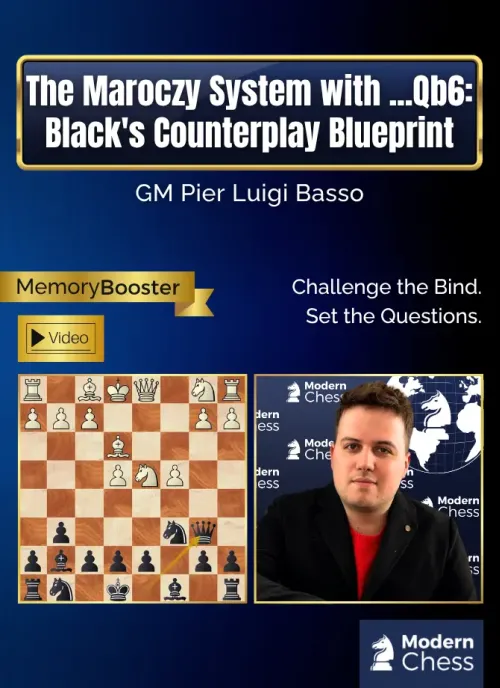
Ask a hundred Accelerated Dragon players why they gave the opening up, and most will point to the same reason: the Maroczy Bind. White plants pawns on c4 and e4, controls d5 twice over, and settles in for the slow, space-heavy game where Black spends many moves — ...Nxd4, ...a5-a4, ...Qa5 — just to earn the right to stay level.
A lot of players look at that prospect and quietly switch openings. GM Pier Luigi Basso's The Maroczy System with ...Qb6 is built for the ones who would rather make White answer first.
1h 48m PGN Available Memory Booster Interactive Tests
PGN Languages:
At the 2026 Sinquefield Cup, Vincent Keymer had a positional resource that would have given him a clear advantage against Sindarov. He never found it. Twenty-six years earlier, in the same type of position, Nigel Short had passed over the very same idea.
Two players from completely different generations, both rated well above 2650, missing the identical point. That is the quiet danger of positional play: the mistake leaves no evidence. No blunder, no lost material — just a position that turns slightly worse while you are still convinced you played a solid game. The hardest part is learning to catch these moments yourself — and that recognition is exactly what Dreev's Universal Positional Playbook is built to train.
2h 54m PGN Available Interactive Tests
PGN Languages:
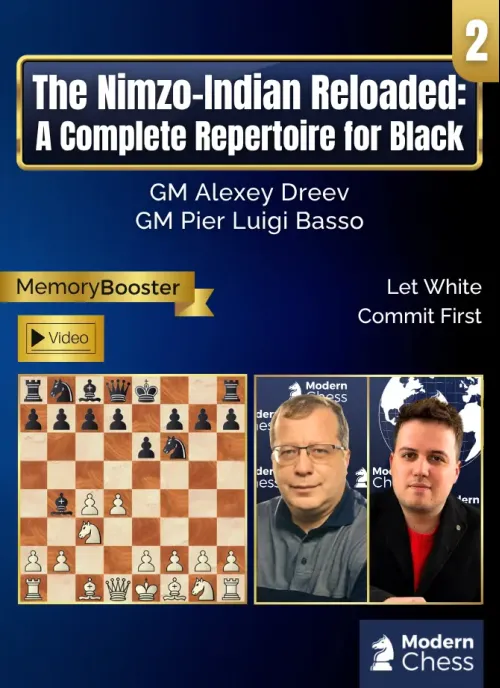
Some ideas wait years for their moment. Back in 2014, with virtually no practical games to lean on, GM Pier Luigi Basso began analyzing a quiet developing move in one of the sharpest corners of the Nimzo-Indian — 8...Nc6 — and then set it aside. It remained largely unexplored until GM Daniel Fridman finally brought it to the board.
Part 2 of The Nimzo-Indian Reloaded is where that idea, and the entire 4.Qc2 complex around it, receives its full treatment. If Part 1 was about out-waiting the Rubinstein, this volume is about reviving a concept that sat dormant for a decade — the "reload" is an old idea given new life.
2h 53m PGN Available Memory Booster Interactive Tests
PGN Languages:

