
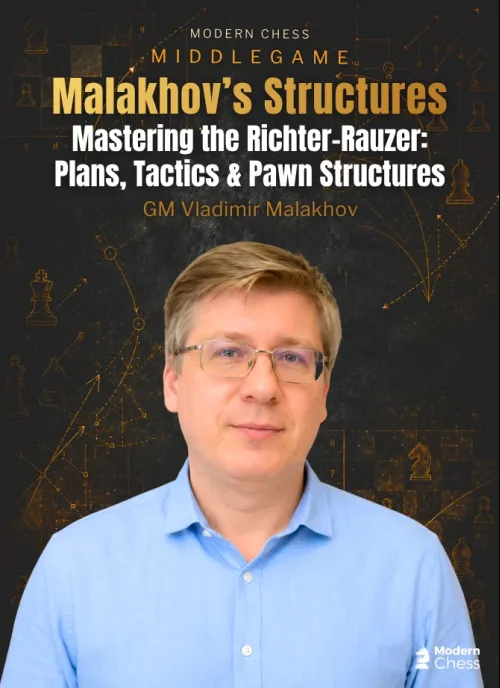
After Bxf6 gxf6, Black's position looks damaged: doubled f-pawns and a king with no comfortable home. Yet this is the Classical Sicilian, the oldest way to play the Sicilian and a choice of World Champions such as Botvinnik, Spassky and Kramnik.
The reason is a paradox at the heart of the Richter-Rauzer. Once the queens leave the board, the broken structure stops being a weakness and becomes a strength.
A structure, not a repertoire
After 1.e4 c5 2.Nf3 d6 3.d4 cxd4 4.Nxd4 Nf6 5.Nc3 Nc6 6.Bg5 e6, White usually plays Qd2, 0-0-0 and Bxf6. Black gets the bishop pair, the half-open g-file and a central pawn mass ready for ...e5 or ...d5.
White aims to open the position with f4-f5 or f4-e5 before Black’s bishops come alive. Black counters with ...a6, ...b5-b4 and the rook on the c-file, always looking for the right moment to trade queens.
3h 40m PGN Available Interactive Tests
PGN Languages:


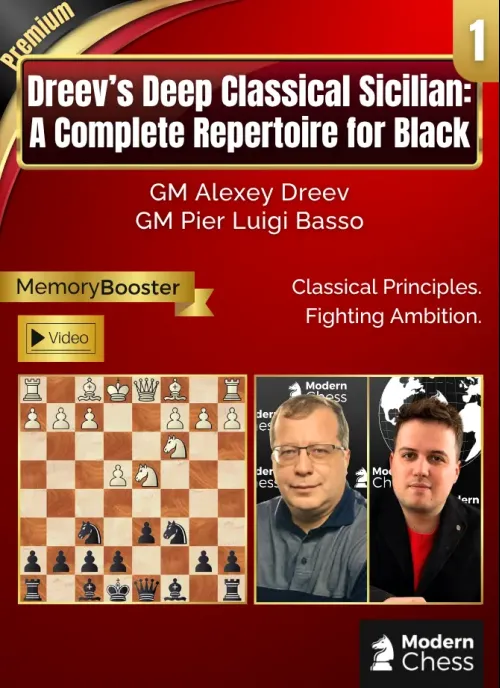
For GM Alexey Dreev, the Sicilian has never been a phase but a lifelong choice. He has played 1...c5 throughout his career, and among all its branches he considers the Classical Variation the most healthy one.
His reasoning is simple. Black develops naturally, fights for the centre and plays for a win, without the volume of forced theory that surrounds the Najdorf. What the Classical demands instead is understanding.
The Rauzer: There Is No Way Around It
Anyone who plays 1.e4 c5 2.Nf3 d6 3.d4 cxd4 4.Nxd4 Nf6 5.Nc3 Nc6 knows which move comes next most often: 6.Bg5, the Richter-Rauzer Attack. As Dreev puts it, a Classical Sicilian player will meet it in every second game.
That is why Part 1 of this repertoire is devoted entirely to 6.Bg5. Black answers with 6...e6, the classical main line. It requires real knowledge, but it gives a repertoire built to last, one that can be played against any opponent.
5h 5m PGN Available Memory Booster Interactive Tests Computer Practice
PGN Languages:

After 1.e4 c5 2.Nf3 d6 3.d4 cxd4 4.Nxd4 Nf6 5.Nc3 a6, White faces probably the most theoretical position in chess. Millions of games have been played, and the main lines are analyzed deep into the middlegame.
Finding something fresh here is a real test. That is the task of this stage.
This database continues the Modern Chess Autumn Challenge. In the Carlsbad stage, four authors built repertoires for Black. Now the challenge switches sides: GM Baadur Jobava, GM Lorenzo Lodici and GM José Martínez Alcántara received the same task, a repertoire for White against the Najdorf. Each of them worked on it independently.
2h 58m PGN Available
PGN Languages:
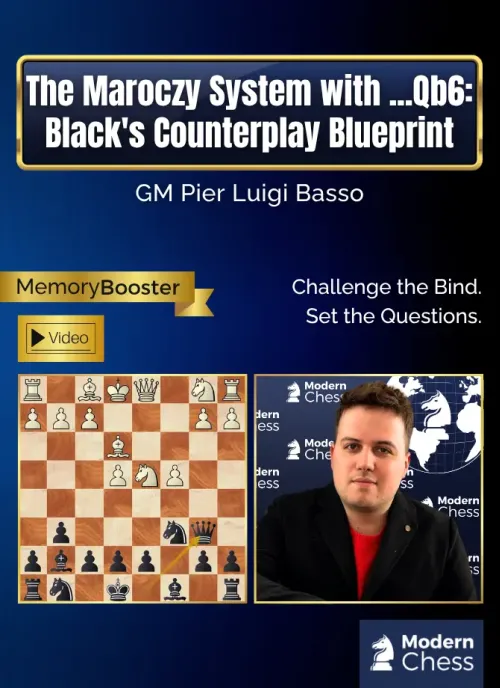
Ask a hundred Accelerated Dragon players why they gave the opening up, and most will point to the same reason: the Maroczy Bind. White plants pawns on c4 and e4, controls d5 twice over, and settles in for the slow, space-heavy game where Black spends many moves — ...Nxd4, ...a5-a4, ...Qa5 — just to earn the right to stay level.
A lot of players look at that prospect and quietly switch openings. GM Pier Luigi Basso's The Maroczy System with ...Qb6 is built for the ones who would rather make White answer first.
1h 48m PGN Available Memory Booster Interactive Tests
PGN Languages:
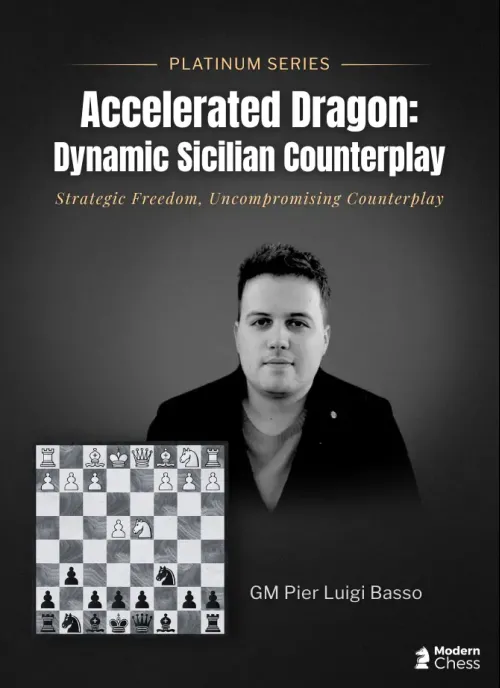
The most uncomfortable recommendations tend to come from the other side of the board. GM Pier Luigi Basso has spent years building and playing White's sharpest tries against the Accelerated Dragon — and in Accelerated Dragon: Dynamic Sicilian Counterplay, he hands Black the exact setup he would least like to meet himself.
The appeal is easy to state. The Accelerated Dragon offers everything the ordinary Dragon does — the bishop on g7, pressure down the c-file, a real three-result game — but with one structural bonus. Because the d-pawn stays on d7, Black keeps ...d5 in reserve as a single move, and the Yugoslav Attack that gives the classical Dragon its reputation never gets the same grip.
3h 22m PGN Available Memory Booster Interactive Tests Computer Practice
PGN Languages:
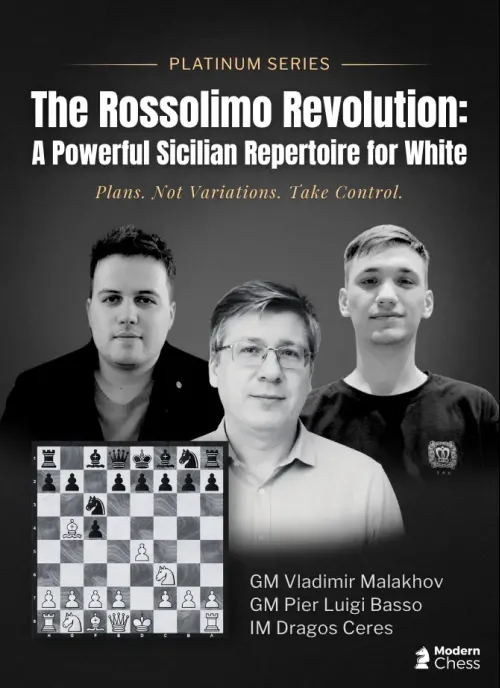
The Open Sicilian is a race of memory — the Sveshnikov, the Taimanov and the Najdorf are ground Black's specialists know well. GM Vladimir Malakhov spent most of his career declining that race. His answer to 2...Nc6 is 3.Bb5, the Rossolimo: White gives up the bishop to damage Black's pawn structure, and in return plays for plans rather than long forcing lines, with clear, durable trumps of his own.
The Rossolimo Revolution: A Powerful Sicilian Repertoire for White, by GM Vladimir Malakhov, GM Pier Luigi Basso and IM Dragos Ceres, is built on that idea and sharpens the old system with directions well off the beaten path.
6h 12m PGN Available Memory Booster Interactive Tests Computer Practice
PGN Languages:

Every Sicilian player learns the same warning early: do not hand White a permanent grip on d5. A knight installed there, with no pawn left to challenge it, is the textbook picture of a Sicilian gone wrong. The Kalashnikov opens by ignoring that warning on move four.
After 1.e4 c5 2.Nf3 Nc6 3.d4 cxd4 4.Nxd4 e5, Black kicks the knight and concedes d5 — not for a moment, but for the rest of the game. Kazakouski is honest about how it looks; his first coach, he writes, would faint at the sight of it. Yet the position Black gets is the opposite of a wreck: quick, natural development, pieces landing on active squares, and a White player left holding a "hole" that still has to be shown to matter. The wager running through the whole repertoire is that, most of the time, it doesn't.
3h 9m PGN Available Memory Booster Interactive Tests
PGN Languages:

Every Classical Sicilian player has a 6.Bg5 file. Ask them to meet it and the answers come quickly, deeply, with confidence. Then White plays 6.Be2, or 6.Bc4, or 6.Be3, or 6.f3 — and the same well-prepared player is suddenly improvising.
These are "sidelines" only because most preparation ignores them, not because they're harmless. Meet one unprepared and the game doesn't crash — it drifts. A natural move here, a slightly worse structure there, until you're defending something you expected to enjoy.
Part of the difficulty is that these tries don't share a single character. 6.Be2 invites a slow, restrained middlegame; 6.Bc4 plants the bishop on Black's most sensitive diagonal; 6.Be3 and 6.f3 point toward the sharp, opposite-side race of English Attack structures. One block of memorized theory was never going to hold them all together, and that is the problem GM Rodrigo Vasquez set out to solve.
He isn't offering new theory to be memorized. He's sharing this material the way he teaches it to his own students — through complete model games, where the plans, the recurring structures, and Black's concrete resources unfold move by move.
3h and 2min PGN Available Interactive Tests
PGN Languages:

Aron Nimzowitsch built a whole way of playing on one unsettling idea: invite your opponent to advance, then turn that advance into a weakness. The Sicilian line that carries his name follows exactly this logic. After 1.e4 c5 2.Nf3 Nf6, Black provokes 3.e5 and then goes to work against it with ...e6 and ...d6.
In The Underrated Nimzowitsch Sicilian - Complete Repertoire for Black, GM Alexey Dreev presents this as one of the most underestimated answers to 1.e4 — a line he calls a personal favorite. He has trusted it in his own games against Caruana and Matlakov, and the course is written in his first-person voice, with GM Pier Luigi Basso as co-author.
2h 50m PGN Available Memory Booster Interactive Tests
PGN Languages:

Some openings are not refuted so much as inherited as refuted. The Lowenthal is the textbook case. For decades it was called dubious, then written off as refuted outright, and most players believed that and moved on. GM Baadur Jobava's starting point is that nobody went back to check the evidence with modern tools — and that when you do, the picture changes. The engine era, so often the executioner of romantic systems, turns out to be the Lowenthal's best defence attorney.
That is the leitmotif running through all nine chapters, including the famous engine "refutation" with 13.Be2 that keeps most players away from the variation entirely. Jobava's conclusion is stated plainly: Black holds, all the way down to a draw the opponent will never find over the board.
1h 34m PGN Available Memory Booster Interactive Tests
PGN Languages: