
Ends in 2d 00:38:16


This variation might be a serious contender replacing the Old Main Line. It does, in my opinion, indeed lead to much more adventurous position than current Main Line of the Catalan, reached after 4...Be7 5.Bg2 0-0 6.0-0 dxc4. One little warning, or rather see it as an encouraging message, particularly the Main Lines after 4...dxc4 5.Bg2 a6, covered in the last chapters contain an incredibly deep, computer-assisted analysis.
We aren't playing this system to equalize, but rather try to put White under pressure by sticking to our extra pawn. We are looking for our own chances! Most of the Chapters offer imbalanced pawn structures or material distribution, offering good practical chances to play for a win, once we leave the theoretical territory.
PGN Available Interactive Tests
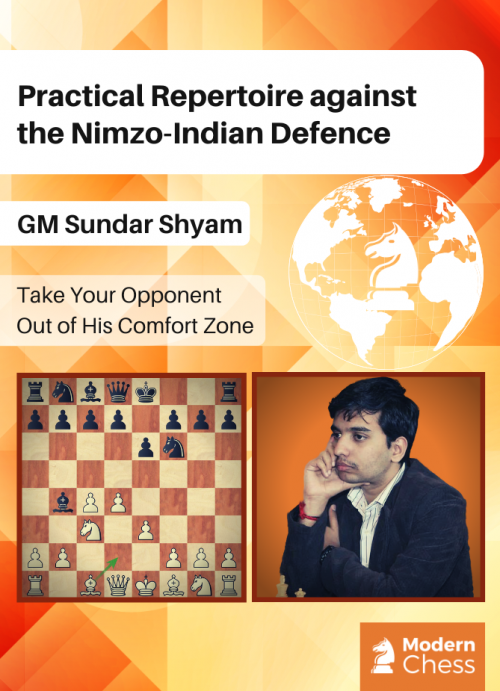
The Nimzo-Indian Defence has always been one of Black's most challenging weapons against 1.d4. How should we meet this opening? The main lines require enormous theoretical knowledge (you should invest a lot of time to study them) while there is no advantage. The modern computers demonstrated more than one way to equalize in all the main systems. Therefore, a more practical approach would be to focus on creating practical problems. In order to achieve it, it is enough to obtain a non-trivial position that you know better than your opponent.
In the current database, GM Sundar Shyam advocates exactly this approach. His repertoire is based on the line 1.d4 Nf6 2.c4 e6 3.Nc3 Bb4 4.e3 0-0 5.Bd2!? (Black's alternatives on move 4 are also dealt with).
The database is divided into three sections - Model Games, Theory, Test Positions. You will find 5 model games, 10 theoretical chapters and 12 interactive test positions.
PGN Available Interactive Tests
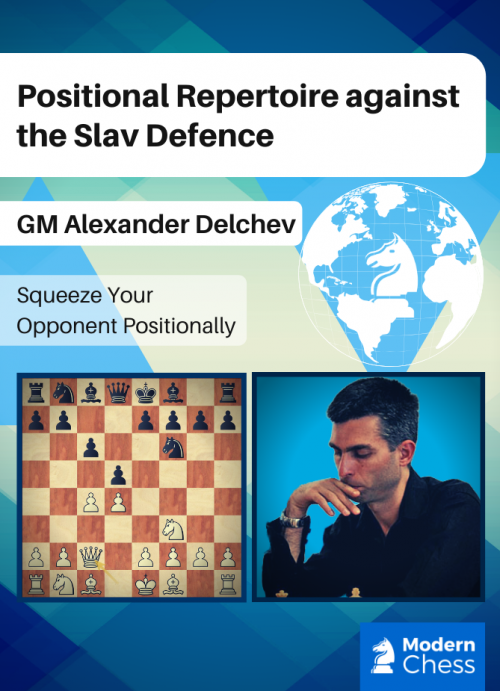
The Slav Defence is one of the most solid ways to meet 1.d4. Therefore, this opening has always been an evergreen choice in high-level chess. Building a repertoire for White is really challenging. Since there is no way to achieve an objective advantage, White shall try to create practical problems and outplay in opponent in strategically complex positions.
In the current database, GM Aleksander Delchev builds a positional repertoire for White. The starting position of his survey arises after 1.d4 d5 2.c4 c6 3.Nf3 Nf6
The main repertoire suggested by GM Delchev is based on 4.Qc2. As an alternative, he also provides a backup repertoire with 4.Qb3. Having two options (which are quite similar strategically) allows you to adjust your choice depending on your opponent.
As already mentioned, this is a positional repertoire. Hence, the understanding of the typical plans and ideas is much more important than the memorization of theoretical lines. Therefore, the author provides an extensive examination of the typical pawn structures.
PGN Available Interactive Tests

This system with 5.e3 is getting very popular recently. It has been employed by a number of top-level players, including Aronian and Ivanchuk. The main point behind White's 5th move is to slow down Black's queenside counterplay. By immediately bringing the f1-bishop into the game, White is trying to hold the important b5-square. Later on, White will reinforce the control of b5 by means of Nc3 and a2-a4. As a result, with the b-file been blocked, Black's queenside counterplay will be highly restricted. If Black goes for a classical Benko structure, (...g7-g6, ...Bg7, . ..d7-d6, ...0-0, and ...axb5) the control of the b5-square will be very important (see the section on the pawn structures). Of course, We should be aware of some drawbacks of the move 5.e3. This move does not contribute to the fight for the centre. Additionally, White would eventually lose a tempo since in most of the lines he will play e3-e4 at some point. Taking these drawbacks into account, Black often opts for dynamic systems which are characterized by the pressure on d5. Nevertheless, my analysis shows that Black cannot solve his problems with dynamic play. In many lines, White gives his pawn back in order to overtake the initiative.
PGN Available Interactive Tests

The Slav Defence is one of the most solid options for Black against 1.d4 and part of any strong grandmaster's repertoire. The main goal is to solve the eternal problem of the light-squared bishop, keeping the chance of developing it either to f5 or g4. White has many options to fight for an advantage, but since Black's structure is very stable, the active options are very limited. The Slav is a nice opening for players that look for solid set-ups and don't care about playing with patience, improving his position slowly and collecting small strategic advantages.
In his trilogy, IM Renato Quintillano is offering a complete repertoire for Black which is rich of new ideas and concepts.
PGN Available Interactive Tests

Queen's Gambit Accepted is one of the most fundamental and reliable openings. In the introduction to the current database, GM Hungaski writes:
One of the reasons why I have been so attracted to this variation over the years (and why I believe I have been so successful with it) is due to the simplicity of Black's ideas and the practicality of the variations themselves. I began playing the Queen's Gambit Accepted nearly ten years ago.
"I remember I was fed up with my bad results against 1.d4 and decided to stay away from long and complex theoretical discussions that were taking up a lot of my time and giving me little returns. Instead, I decided to choose an opening that would narrow down White's possibilities even if this meant accepting a slightly inferior (though very solid) position. To my surprise, I soon found out that White's road to advantage is not an easy one if there is one at all. In the analysis that follows, I hope to make a strong case in favour of this timeless opening based on the soundness of the arising positions and especially on the overall practicality of this opening".
PGN Available Interactive Tests

In his first database for Modern Chess, IM Luis Rodi provides an ambitious repertoire against the Catalan. The repertoire starts with 1.d4 d5 2.c4 e6 3.Nf3 Nf6 4.g3 Bb4+ (the authors also deals with the systems in which White delays Nf3 or c2-c4). The theoretical approach of IM Rodi is based on an in-depth analysis of positions with many pieces on the board and mutual chances. The author tends to favour aggressive ideas. Nevertheless, all his lines are completely justified from a positional point of view.
PGN Available Interactive Tests

In the second part of his repertoire after 1.d4 Nf6 2.c4 g6 3.g3, GM Michael Roiz deals with the King's Indian Defence as well as with the systems based on Black's early ...c7-c5.
True to his approach, the author usually suggests creative ideas which have been underestimated from a theoretical point of view. Each one of these lines, however, is based on solid positional foundations. Being classical and modern at the same time, this repertoire offers a very high practical value to the tournament player.
The database consists of three parts - Typical Pawn Structures, Theoretical Section, and Test Section.
PGN Available Interactive Tests

The modern way of fighting King's Indian Defense involves a little move h2-h3. Its idea is not just to protect g4-square from ...Ng4 and ...Bg4 sorties, but also to prepare ambitious g2-g4 expansion. This can be a very effective prophylactic measure against Black's typical kingside play, as well as a springboard to White's kingside attack(!) - as discovered by the Soviet Grandmaster Vladimir Makogonov, after whom this whole system was named.
White has traditionally used a combination of Ng1-f3 and h2-h3 on moves 5 and 6 to achieve this setup, which was investigated by Grandmaster Mihail Marin in another Modern chess database.
PGN Available Interactive Tests

GM Mihail Roiz starts a very ambitious project. In two databases, he will provide a complete White’s repertoire after the moves 1.d4 Nf6 2.c4 g6 3.g3.
The fianchetto variation against King's Indian Defence and Grunfeld is very popular at all levels. It is considered to be the safest way to play with White.
Loyal to his style, GM Roiz builds a repertoire which is not based on the most popular continuations. He provides a variety of new ideas in many important positions. Furthermore, his work brings new life to old forgotten lines.
The first database is dedicated to the Grunfeld Defence. The database consists of 12 theoretical chapters and 15 test positions.
PGN Available Interactive Tests