
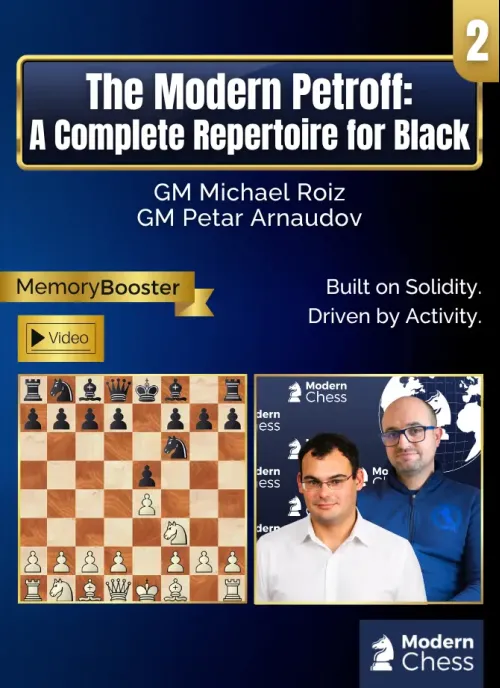
With 3.d4, the Steinitz Variation, White opens the centre at once. The promise behind the move is easy to understand. The position opens before Black has finished development, and White hopes the open lines will favour the side that moves first.
The Modern Petroff: A Complete Repertoire for Black – Part 2, by GM Michael Roiz and GM Petar Arnaudov, turns that promise around. After 3...Nxe4, Black's pieces come out quickly. In many lines Black is ready to give up a pawn in return for activity and pressure on White's centre.
1h 40m PGN Available Memory Booster Interactive Tests
PGN Languages:


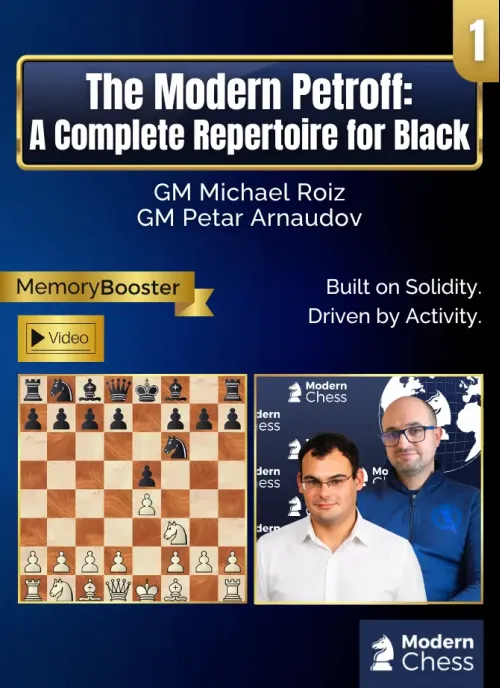
For decades the Petroff Defence has carried a reputation it never quite deserved. Its solidity at the very top earned it a place in world championship preparation, but the same solidity left it labelled as a drawing weapon, an opening Black chooses in order to hold rather than to play for more.
The Modern Petroff: A Complete Repertoire for Black – Part 1, by GM Michael Roiz and GM Petar Arnaudov, starts from a different premise. Reliable does not have to mean passive.
1h 55m PGN Available Memory Booster Interactive Tests
PGN Languages:
After Bxf6 gxf6, Black's position looks damaged: doubled f-pawns and a king with no comfortable home. Yet this is the Classical Sicilian, the oldest way to play the Sicilian and a choice of World Champions such as Botvinnik, Spassky and Kramnik.
The reason is a paradox at the heart of the Richter-Rauzer. Once the queens leave the board, the broken structure stops being a weakness and becomes a strength.
A structure, not a repertoire
After 1.e4 c5 2.Nf3 d6 3.d4 cxd4 4.Nxd4 Nf6 5.Nc3 Nc6 6.Bg5 e6, White usually plays Qd2, 0-0-0 and Bxf6. Black gets the bishop pair, the half-open g-file and a central pawn mass ready for ...e5 or ...d5.
White aims to open the position with f4-f5 or f4-e5 before Black’s bishops come alive. Black counters with ...a6, ...b5-b4 and the rook on the c-file, always looking for the right moment to trade queens.
3h 40m PGN Available Interactive Tests
PGN Languages:
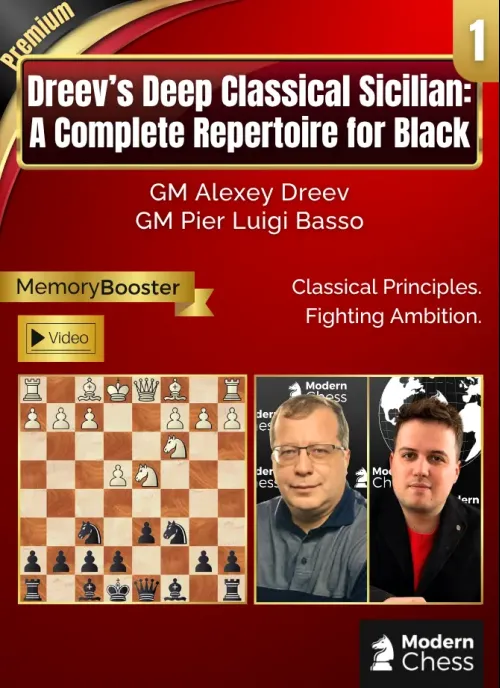
For GM Alexey Dreev, the Sicilian has never been a phase but a lifelong choice. He has played 1...c5 throughout his career, and among all its branches he considers the Classical Variation the most healthy one.
His reasoning is simple. Black develops naturally, fights for the centre and plays for a win, without the volume of forced theory that surrounds the Najdorf. What the Classical demands instead is understanding.
The Rauzer: There Is No Way Around It
Anyone who plays 1.e4 c5 2.Nf3 d6 3.d4 cxd4 4.Nxd4 Nf6 5.Nc3 Nc6 knows which move comes next most often: 6.Bg5, the Richter-Rauzer Attack. As Dreev puts it, a Classical Sicilian player will meet it in every second game.
That is why Part 1 of this repertoire is devoted entirely to 6.Bg5. Black answers with 6...e6, the classical main line. It requires real knowledge, but it gives a repertoire built to last, one that can be played against any opponent.
5h 5m PGN Available Memory Booster Interactive Tests Computer Practice
PGN Languages:

After 1.e4 c5 2.Nf3 d6 3.d4 cxd4 4.Nxd4 Nf6 5.Nc3 a6, White faces probably the most theoretical position in chess. Millions of games have been played, and the main lines are analyzed deep into the middlegame.
Finding something fresh here is a real test. That is the task of this stage.
This database continues the Modern Chess Autumn Challenge. In the Carlsbad stage, four authors built repertoires for Black. Now the challenge switches sides: GM Baadur Jobava, GM Lorenzo Lodici and GM José Martínez Alcántara received the same task, a repertoire for White against the Najdorf. Each of them worked on it independently.
2h 58m PGN Available
PGN Languages:
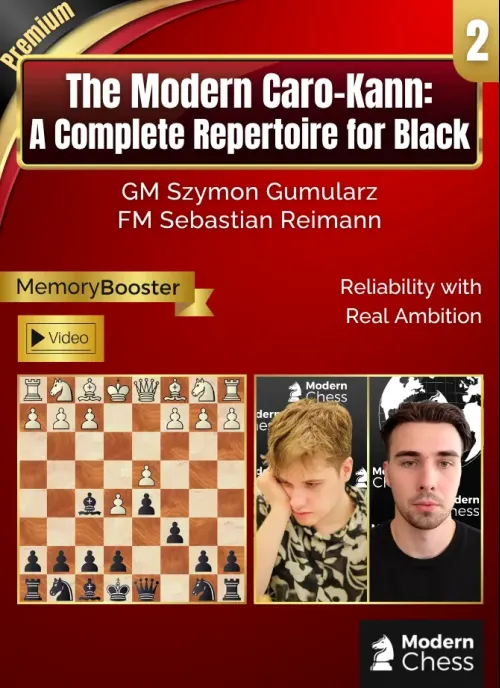
This course, Part 2 of The Modern Caro-Kann, offers a complete Black repertoire against the Advance Variation, built around GM Szymon Gumularz's ambitious 7...c4!? in the Short System, which keeps pieces on the board and plays for a win rather than settling for a theoretical endgame. Across 15 chapters, it provides concrete answers to every major White setup after 1.e4 c6 2.d4 d5 3.e5 Bf5, guided by the principle that Black should never settle for equality when a fighting alternative exists.
5h 15m PGN Available Memory Booster Interactive Tests Computer Practice
PGN Languages:
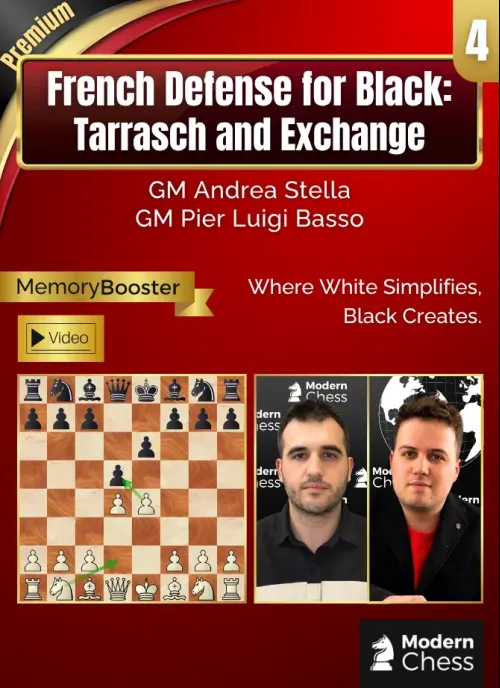
Every French player knows the moment. You brace for the theoretical fights of 3.Nc3, and instead White slides the knight to d2 or simply trades on d5. These are not attempts to refute your opening — they are attempts to drain it of life. The Tarrasch and the Exchange are the practical player's tools: low theory, low risk, and built on the quiet hope that Black will grow bored, passive, or both.
GM Andrea Stella and GM Pier Luigi Basso built this fourth and final part to reject that bargain. Their repertoire takes the two lines French players meet quite often and reframes them as positions Black plays for a win — not through wild complications, but through a chain of deliberate second choices that keep tension exactly where the mainlines offer symmetry.
5h 55m PGN Available Memory Booster Interactive Tests Computer Practice
PGN Languages:
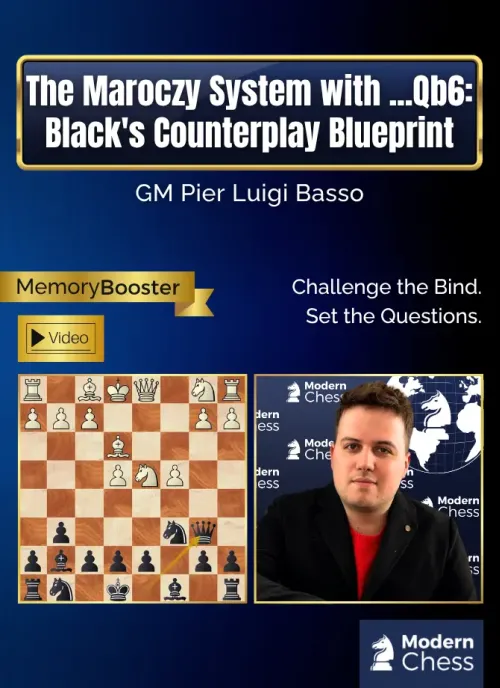
Ask a hundred Accelerated Dragon players why they gave the opening up, and most will point to the same reason: the Maroczy Bind. White plants pawns on c4 and e4, controls d5 twice over, and settles in for the slow, space-heavy game where Black spends many moves — ...Nxd4, ...a5-a4, ...Qa5 — just to earn the right to stay level.
A lot of players look at that prospect and quietly switch openings. GM Pier Luigi Basso's The Maroczy System with ...Qb6 is built for the ones who would rather make White answer first.
1h 48m PGN Available Memory Booster Interactive Tests
PGN Languages:
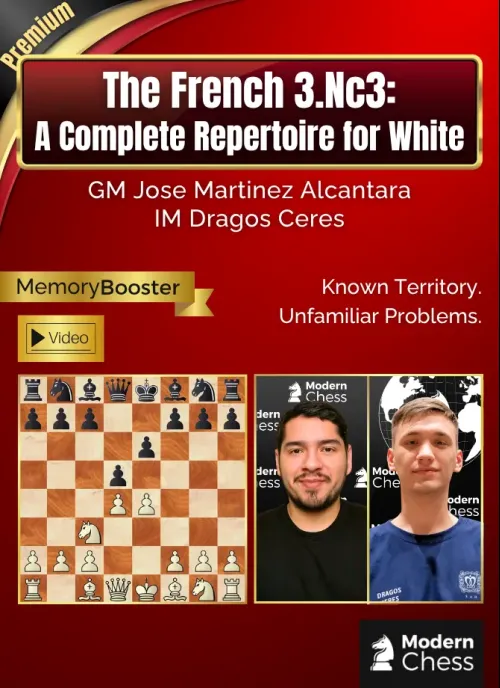
For a hundred years, the French has been the opening where the defender knows the ground better than the attacker. The Winawer and the Steinitz have been mapped move by move for generations, and the French specialist arrives at the board expecting White to be the first to run out of memory. The French 3.Nc3: A Complete Repertoire for White was built to reverse that expectation.
The method is not to out-analyse a century of theory but to step around it. In every principal line the repertoire turns toward positions with a few hundred games in the database rather than tens of thousands — places where understanding the plan matters more than recalling the next fifteen moves, and where Black is left to think independently remarkably early.
4h 7m PGN Available Memory Booster Interactive Tests Computer Practice
PGN Languages:
More than almost any other opening, the French is defined by its endgames — the middlegames flow again and again into the same recurring family of positions, and the player who understands them holds a lasting edge over the one who merely reaches them. Across four lectures, GM Ioannis Papaioannou covers the typical endings of the Advance, Tarrasch, Winawer and Exchange variations: the isolated-pawn structures and the critical light-squared bishop trade, the d4/e5 pawn chain, and the doubled c-pawns of the Winawer and MacCutcheon.
6h PGN Available Interactive Tests