OpeningRepertoire BuilderDiscounted
GM Grigor Grigorov · Oct 7, 2026
The final volume of the six-month Réti project, and the one that completes the system. Where Theoretical Knowledge, Part 1 answered everything Black tries with ...d5, Part 2 takes on the whole remaining field: the Réti Slav and the Tarrasch Defence, the Hedgehog and double fianchetto, the Dutch in both its Leningrad and Stonewall forms, the Symmetrical English and the Wedberg System, the King's Indian Fianchetto — and the ...g6 setups, met with a clear decision to play 2.e4. Theory is given where theory is required, but always on top of the structures built across the first four months, which is why it can be absorbed quickly rather than memorised painfully.
6h
PGN


OpeningRepertoire BuilderDiscounted
GM Grigor Grigorov · Aug 13, 2026
After four months of studying the fundamental structures of the 1.Nf3 complex — Réti and Catalan-type formations, King's Indian and Grünfeld structures, English Opening positions with symmetrical setups, Hedgehog formations and Maróczy-type structures — we are now ready to translate that understanding into concrete theoretical preparation.
In this phase, theory is no longer kept light. We look at concrete move orders and specific variations, where precise theoretical knowledge is required. The bet the whole project has been making is cashed in here: with the typical ideas and structures already familiar, the theory is absorbed quickly rather than memorised painfully.
This first half of the theoretical part covers all Black setups involving the move ...d5.
The material is based on the camp of the same name and is now transformed into a complete digital product, including full video recordings of all lectures, a structured PGN file following the logic of the training sessions, and extensive theoretical analysis for deeper study.
7h 39m
PGN

OpeningRepertoire BuilderDiscounted
GM Grigor Grigorov · Aug 13, 2026
The Opening Builder – Réti for White: Fundamental Structures after 1.Nf3 c5 2.c4 is the fourth part of our six-month Réti project. It continues the work started in the first course on the structures after 1.Nf3 d5 2.g3, the second on 1.Nf3 Nf6 2.c4 e6 3.g3, and the third on 1.Nf3 Nf6 2.c4 g6 3.Nc3.
This part addresses what happens when Black meets our move order with the most independent try of all — 1...c5, steering the game into the English Opening complex. These are among the most flexible and strategically rich positions in modern chess: symmetrical setups, Hedgehog formations, and Maróczy-type structures, all of which are central to a 1.Nf3 repertoire and all of which reward deep structural understanding rather than concrete preparation.
The material is based on the camp of the same name and is now transformed into a complete digital product. It includes full video recordings of all lectures, a structured PGN file that follows the logic of the training sessions, and additional model games and theoretical examples for further study.
6h 9m
PGN
GM Nijat Abasov · Aug 3, 2026
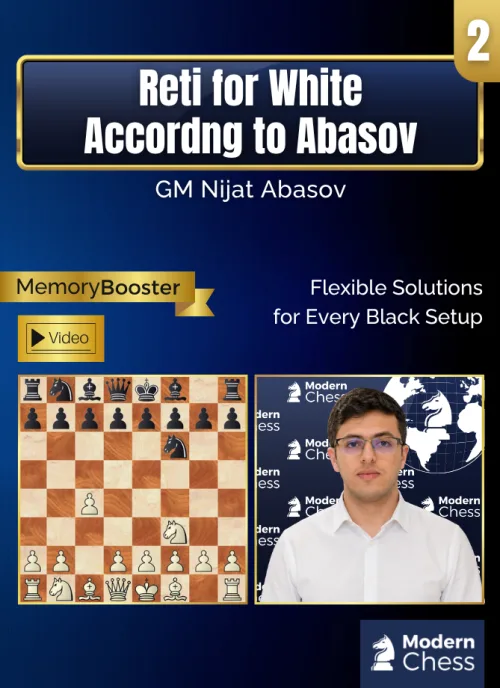
Most openings ask White to commit the d-pawn early and then defend the theory that follows. The Reti is built on the opposite instinct. After 1.Nf3 and 2.c4, White leaves the center fluid, holds d4 in reserve, and lets Black declare his plan first. In The Reti According to Abasov – Part 2, GM Nijat Abasov builds a repertoire around 1...Nf6 — the move Black uses to keep his options open, ready to steer toward a King's Indian, a Grünfeld, a Queen's Indian, or a symmetrical English. Abasov's reply is to keep his own hand hidden just as long, and to answer each of those tries on his own terms.
Where Part 1 handled 1...d5, Part 2 answers 1...Nf6, and Abasov makes a deliberate choice here: not one universal system, but a reply shaped to each of Black's setups. In his own words, he wanted "a different approach to be more flexible." Against the Queen's Indian setup he declines the routine d4 structures for something sharper; against the symmetrical English he sidesteps the forcing 3.d4 and 3.Nc3, playing 3.g3 to press with his extra tempo; against the Grünfeld he keeps an Anti-Grünfeld type-of-position with d4 still unplayed. The effect is to keep Black in positions he meets far less often than the heavily analyzed main lines.
3h
PGN

 Memory Booster
Interactive Tests


GM Mahammad Muradli · Jul 29, 2026
The Réti is an opening of restraint. Rather than plant a pawn on the fourth rank, White fianchettoes the bishop, holds back d4, and pressures the center from a distance — hoping Black commits too early. Against that patience, genuine counterplay is hard to come by, and most of Black's ambitious tries invite exactly the kind of positional squeeze the setup is built to produce.
In The Dynamic Anti-Réti: 2...c5, GM Mahammad Muradli turns that philosophy around. After 1.Nf3 d5 2.g3, Black plays 2...c5, claiming space and taking control over the d4-square. Then comes the move that gives the repertoire its identity: 3.Bg2 f6!?, preparing ...e5 and a broad classical center before a single piece has left the back rank.
2h 46m
PGN
Memory Booster
Interactive Tests

GM Ioannis Papaioannou · Jul 4, 2026
Most players who face 1.Nf3 d5 reach for the classical 2.g3 Réti or transpose with 2.c4 — GM Ioannis Papaioannou offers a third path with 2.b3, keeping all the flexibility of the Réti while sidestepping its most analysed theory. Built from his camp on the system, the course meets every Black setup — ...Bf5, ...Bg4, ...e6, ...g6 and ...c5 — with clear plans built on long-range pressure from the b2-bishop, the well-timed light-squared-bishop trade, and a principled d2–d4. The result is a complete, low-theory repertoire for White that poses real problems from the very first moves — preparation your opponents are rarely ready for.
10h 30m
PGN