
At the 2026 Sinquefield Cup, Vincent Keymer had a positional resource that would have given him a clear advantage against Sindarov. He never found it. Twenty-six years earlier, in the same type of position, Nigel Short had passed over the very same idea.
Two players from completely different generations, both rated well above 2650, missing the identical point. That is the quiet danger of positional play: the mistake leaves no evidence. No blunder, no lost material — just a position that turns slightly worse while you are still convinced you played a solid game. The hardest part is learning to catch these moments yourself — and that recognition is exactly what Dreev's Universal Positional Playbook is built to train.
2h 54m PGN Available Interactive Tests
PGN Languages:


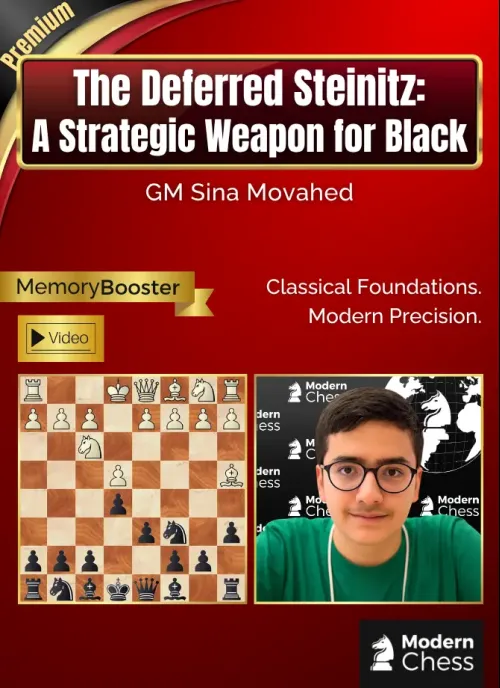
Wilhelm Steinitz built his legacy on a single, radical idea: that sound defence could outlast the most brilliant attack. The opening that still carries his name — the Deferred Steinitz, 1.e4 e5 2.Nf3 Nc6 3.Bb5 a6 4.Ba4 d6 — inherited that DNA. Protect the centre, develop without haste, and let solidity do the work.
For more than a century that solidity came with a quiet reputation to match. In The Deferred Steinitz – A Strategic Weapon for Black, GM Sina Movahed keeps the soundness and deletes the passivity. His version of the old defence is built to play for a win against the Ruy Lopez.
3h 11m PGN Available Memory Booster Interactive Tests Computer Practice
PGN Languages:
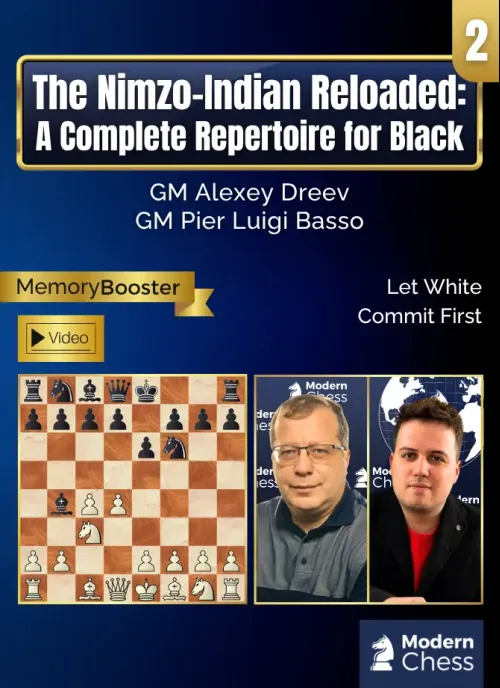
Some ideas wait years for their moment. Back in 2014, with virtually no practical games to lean on, GM Pier Luigi Basso began analyzing a quiet developing move in one of the sharpest corners of the Nimzo-Indian — 8...Nc6 — and then set it aside. It remained largely unexplored until GM Daniel Fridman finally brought it to the board.
Part 2 of The Nimzo-Indian Reloaded is where that idea, and the entire 4.Qc2 complex around it, receives its full treatment. If Part 1 was about out-waiting the Rubinstein, this volume is about reviving a concept that sat dormant for a decade — the "reload" is an old idea given new life.
2h 53m PGN Available Memory Booster Interactive Tests
PGN Languages:
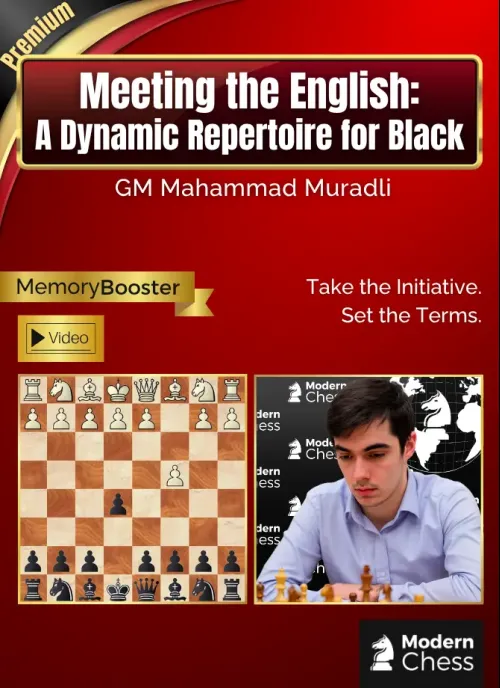
The English Opening can be like a Sicilian with an extra tempo, and White usually spends that tempo on comfort. Develop quietly, keep the centre fluid, wait to see how Black commits, and only then choose a plan. The whole appeal of 1.c4 is that White gets to be patient while Black reacts.
GM Mahammad Muradli's repertoire is built to take that comfort away. From the opening moves, Black becomes the side asking the questions — either out-waiting White with a quiet finesse, or forcing an immediate confrontation in the centre. The tempo may belong to White, but the initiative does not.
3h 59m PGN Available Memory Booster Interactive Tests Computer Practice
PGN Languages:
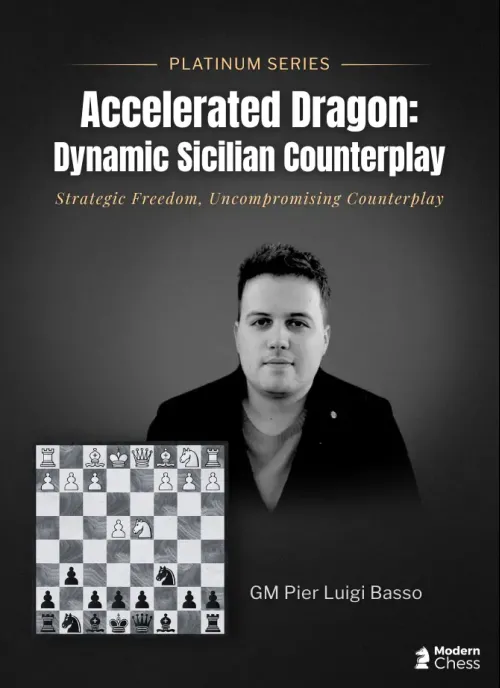
The most uncomfortable recommendations tend to come from the other side of the board. GM Pier Luigi Basso has spent years building and playing White's sharpest tries against the Accelerated Dragon — and in Accelerated Dragon: Dynamic Sicilian Counterplay, he hands Black the exact setup he would least like to meet himself.
The appeal is easy to state. The Accelerated Dragon offers everything the ordinary Dragon does — the bishop on g7, pressure down the c-file, a real three-result game — but with one structural bonus. Because the d-pawn stays on d7, Black keeps ...d5 in reserve as a single move, and the Yugoslav Attack that gives the classical Dragon its reputation never gets the same grip.
3h 22m PGN Available Memory Booster Interactive Tests Computer Practice
PGN Languages:
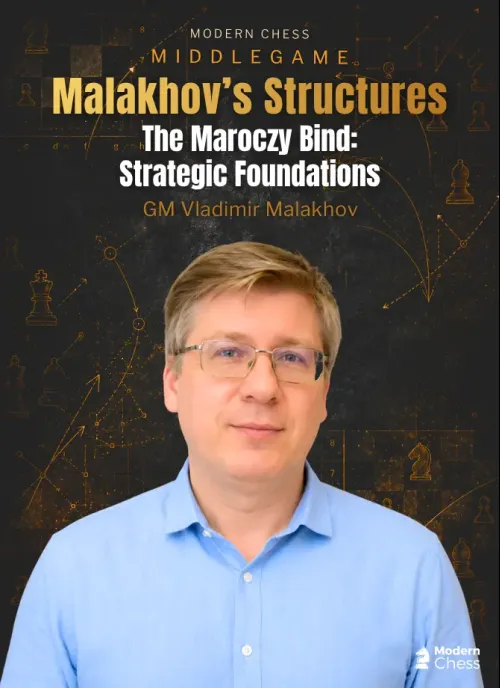
The Maroczy Bind carries the name of a player who never set it up with the white pieces. As Malakhov points out, Géza Maroczy — oddly enough — never played the structure as White at all; he appears on the Black side of the game that gave it its name, Swiderski–Maroczy, Monte Carlo 1904.
It is a fitting emblem for a structure that always had to be read from both sides of the board. The same two pawns on c4 and e4 can mean a slow, suffocating squeeze or a springboard for counterplay, depending entirely on who understands the position better.
That double vision is the premise of The Maroczy Bind - Strategic Foundations by GM Vladimir Malakhov. It is a structures course, not a repertoire — there are no long forcing lines to memorise. Instead it studies the formation itself: what each side is trying to do, which pieces to exchange and which to keep, where the pawn breaks live, and the exact moment a natural-looking move becomes a serious error.
Sequence: Universal Pawn Structures »
3h 59m PGN Available Interactive Tests
PGN Languages:
Material is the first thing chess teaches you to count, and the last thing you learn to distrust — the moment someone gives up the exchange for a square, the arithmetic stops working. This Guided Practice course trains the judgment that replaces it, across four themes: gambit play in attack and defence, positional exchange sacrifices, long-term piece sacrifices, and the remaining forms of imbalance. Examples run from Chigorin and Botvinnik to Anand, Shirov and Abdusattorov, with each exercise asking you to decide before the solution is revealed.
2h 10m PGN Available Interactive Tests
Where Part 1 treated pawns as structure at rest, Part 2 puts them in motion: the storm thrown at a castled king, the blockade that freezes an opponent's play, the defence that meets an avalanche, and the rook-pawn advance that modern practice has turned into a standard weapon. Petrosian anchors the blockading material, while Carlsen, Ding Liren and Gukesh illustrate the newest ideas. Four themes, trained the Guided Practice way — decide first, then compare.
2h 9m PGN Available Interactive Tests
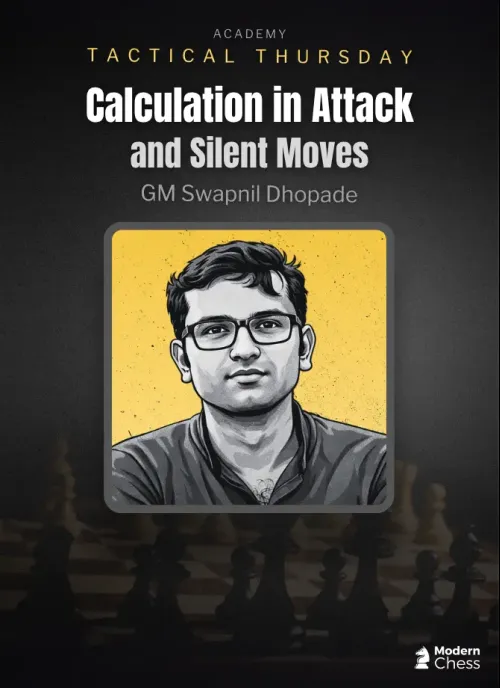
Calculation is really two skills pulling in opposite directions: the fast, forcing sequence that decides an attack, and the quiet move that decides everything else. "What is the move that changes nothing — and yet changes everything?" — GM Dhopade trains both, from converting an attacking intuition into a concrete win to spotting the silent resource most players walk straight past. The most extensive exercise collection in the series, with full solutions, lecture recordings, and PGN.
6h PGN Available Interactive Tests
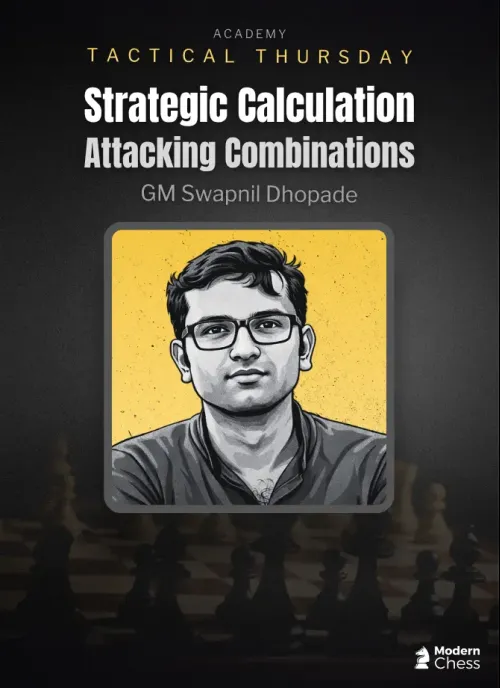
We are taught that strategy means quiet manoeuvring and calculation means tactics, but GM Dhopade's point is that strategic advantages often have to be calculated for — candidate moves and forcing lines used to win a positional argument rather than material. The course pairs that idea with a session on attacking combinations, which sharpen the same skill through sacrifice and pattern. Fifteen test positions with full solutions, plus complete lecture recordings and PGN.
6h PGN Available Interactive Tests