
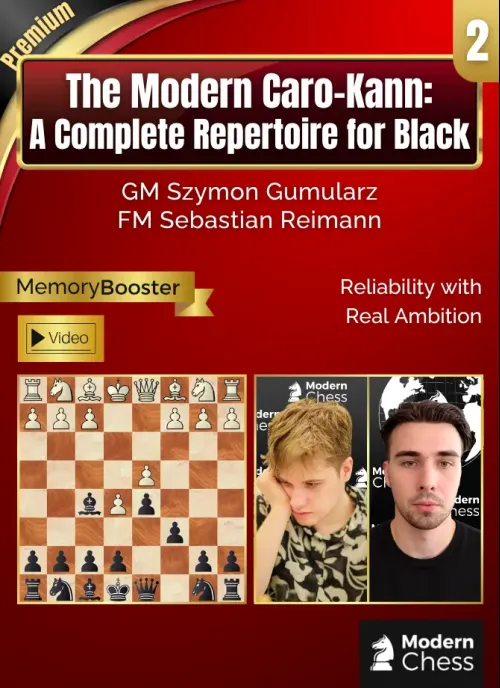
This course, Part 2 of The Modern Caro-Kann, offers a complete Black repertoire against the Advance Variation, built around GM Szymon Gumularz's ambitious 7...c4!? in the Short System, which keeps pieces on the board and plays for a win rather than settling for a theoretical endgame. Across 15 chapters, it provides concrete answers to every major White setup after 1.e4 c6 2.d4 d5 3.e5 Bf5, guided by the principle that Black should never settle for equality when a fighting alternative exists.
5h 15m PGN Available Memory Booster Interactive Tests Computer Practice
PGN Languages:


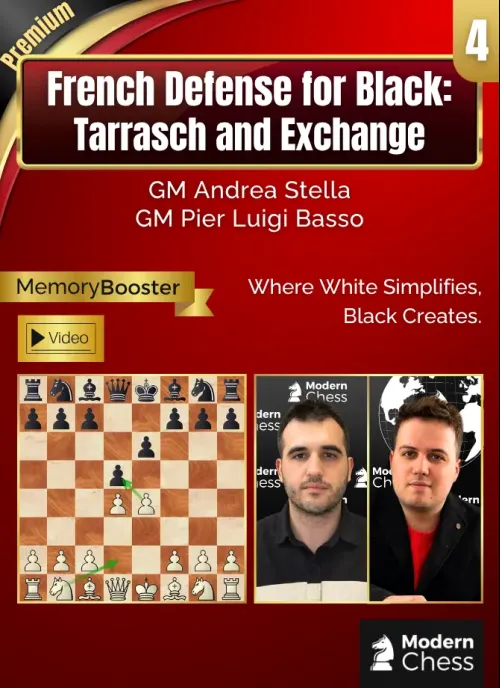
Every French player knows the moment. You brace for the theoretical fights of 3.Nc3, and instead White slides the knight to d2 or simply trades on d5. These are not attempts to refute your opening — they are attempts to drain it of life. The Tarrasch and the Exchange are the practical player's tools: low theory, low risk, and built on the quiet hope that Black will grow bored, passive, or both.
GM Andrea Stella and GM Pier Luigi Basso built this fourth and final part to reject that bargain. Their repertoire takes the two lines French players meet quite often and reframes them as positions Black plays for a win — not through wild complications, but through a chain of deliberate second choices that keep tension exactly where the mainlines offer symmetry.
5h 55m PGN Available Memory Booster Interactive Tests Computer Practice
PGN Languages:
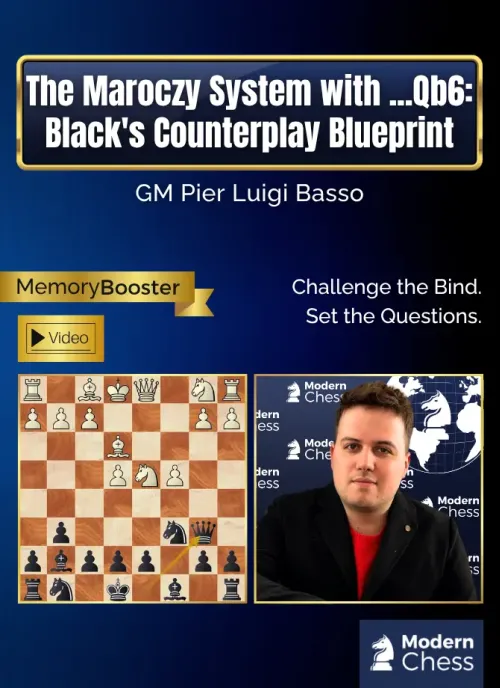
Ask a hundred Accelerated Dragon players why they gave the opening up, and most will point to the same reason: the Maroczy Bind. White plants pawns on c4 and e4, controls d5 twice over, and settles in for the slow, space-heavy game where Black spends many moves — ...Nxd4, ...a5-a4, ...Qa5 — just to earn the right to stay level.
A lot of players look at that prospect and quietly switch openings. GM Pier Luigi Basso's The Maroczy System with ...Qb6 is built for the ones who would rather make White answer first.
1h 48m PGN Available Memory Booster Interactive Tests
PGN Languages:
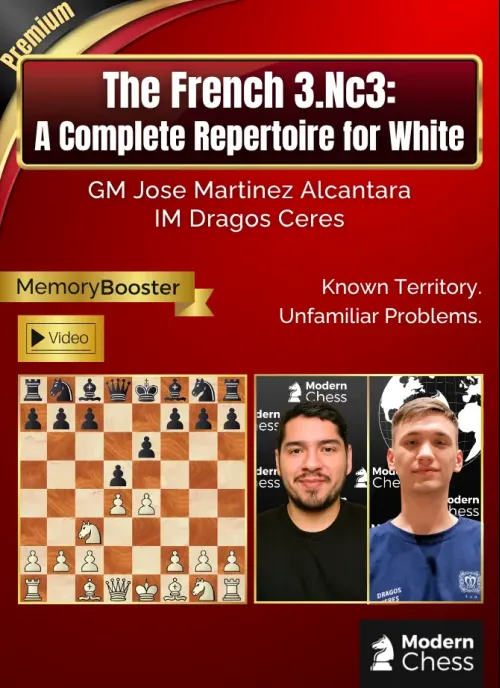
For a hundred years, the French has been the opening where the defender knows the ground better than the attacker. The Winawer and the Steinitz have been mapped move by move for generations, and the French specialist arrives at the board expecting White to be the first to run out of memory. The French 3.Nc3: A Complete Repertoire for White was built to reverse that expectation.
The method is not to out-analyse a century of theory but to step around it. In every principal line the repertoire turns toward positions with a few hundred games in the database rather than tens of thousands — places where understanding the plan matters more than recalling the next fifteen moves, and where Black is left to think independently remarkably early.
4h 7m PGN Available Memory Booster Interactive Tests Computer Practice
PGN Languages:
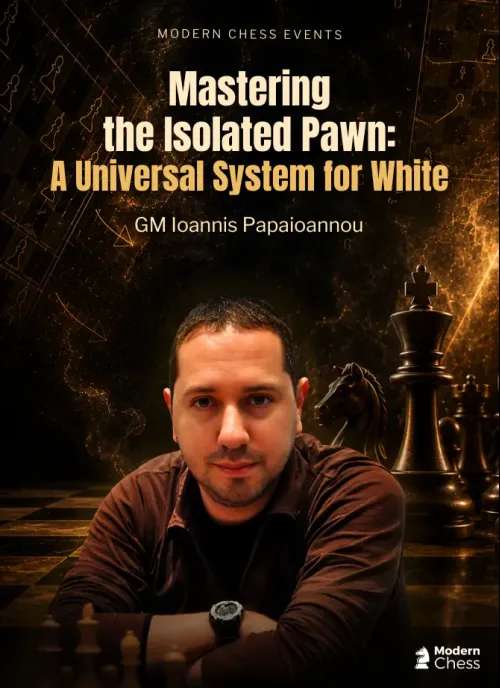
After 1.d4 Nf6 2.c4 e6 3.Nf3 c5 4.e3 d5, the game reaches an isolated queen's pawn structure that belongs to no single opening — the very same positions arise from the Panov Attack, the Semi-Tarrasch, the Queen's Gambit Declined and the Symmetrical English, so learning to handle them once pays off for the rest of your career. Across seven lectures, GM Ioannis Papaioannou begins with two full sessions on the attacking ideas and technical procedures of the structure itself, then builds the concrete repertoire on top: the immediate 4...d5, the Panov tabiya after 5.exd4 d5, and Black's attempts to stay flexible.
10h 37m PGN Available Interactive Tests
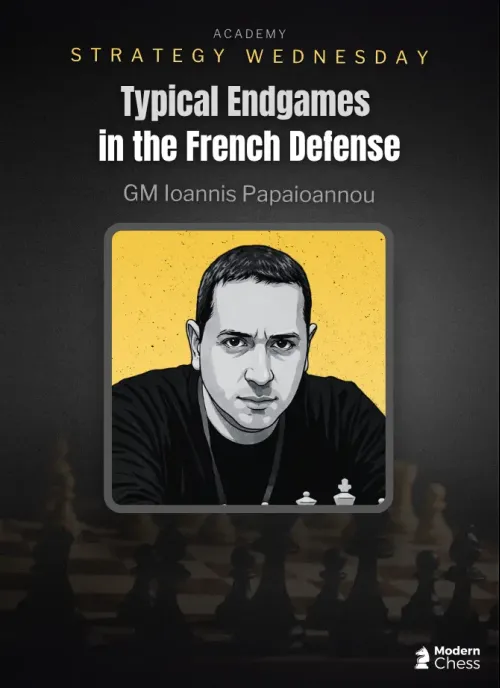
More than almost any other opening, the French is defined by its endgames — the middlegames flow again and again into the same recurring family of positions, and the player who understands them holds a lasting edge over the one who merely reaches them. Across four lectures, GM Ioannis Papaioannou covers the typical endings of the Advance, Tarrasch, Winawer and Exchange variations: the isolated-pawn structures and the critical light-squared bishop trade, the d4/e5 pawn chain, and the doubled c-pawns of the Winawer and MacCutcheon.
6h PGN Available Interactive Tests

At the 2026 Sinquefield Cup, Vincent Keymer had a positional resource that would have given him a clear advantage against Sindarov. He never found it. Twenty-six years earlier, in the same type of position, Nigel Short had passed over the very same idea.
Two players from completely different generations, both rated well above 2650, missing the identical point. That is the quiet danger of positional play: the mistake leaves no evidence. No blunder, no lost material — just a position that turns slightly worse while you are still convinced you played a solid game. The hardest part is learning to catch these moments yourself — and that recognition is exactly what Dreev's Universal Positional Playbook is built to train.
2h 54m PGN Available Interactive Tests
PGN Languages:
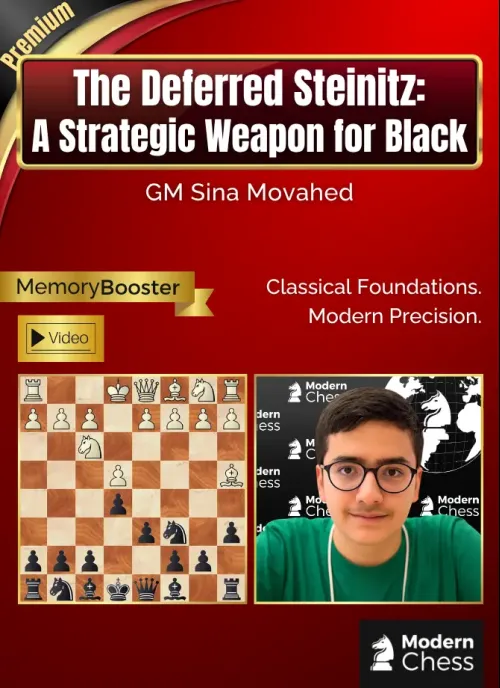
Wilhelm Steinitz built his legacy on a single, radical idea: that sound defence could outlast the most brilliant attack. The opening that still carries his name — the Deferred Steinitz, 1.e4 e5 2.Nf3 Nc6 3.Bb5 a6 4.Ba4 d6 — inherited that DNA. Protect the centre, develop without haste, and let solidity do the work.
For more than a century that solidity came with a quiet reputation to match. In The Deferred Steinitz – A Strategic Weapon for Black, GM Sina Movahed keeps the soundness and deletes the passivity. His version of the old defence is built to play for a win against the Ruy Lopez.
3h 11m PGN Available Memory Booster Interactive Tests Computer Practice
PGN Languages:
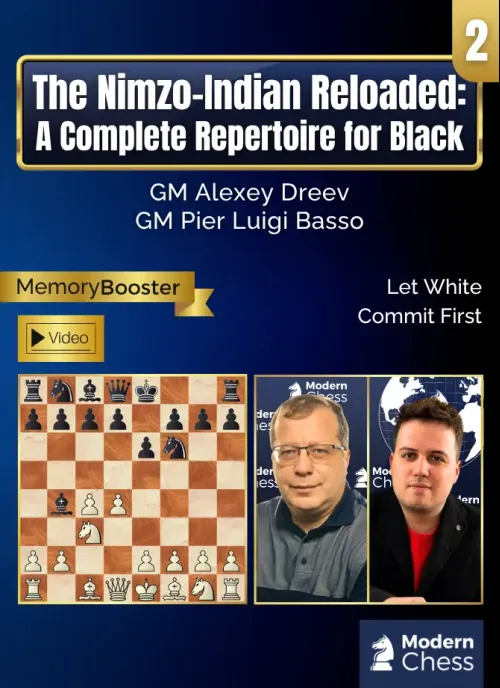
Some ideas wait years for their moment. Back in 2014, with virtually no practical games to lean on, GM Pier Luigi Basso began analyzing a quiet developing move in one of the sharpest corners of the Nimzo-Indian — 8...Nc6 — and then set it aside. It remained largely unexplored until GM Daniel Fridman finally brought it to the board.
Part 2 of The Nimzo-Indian Reloaded is where that idea, and the entire 4.Qc2 complex around it, receives its full treatment. If Part 1 was about out-waiting the Rubinstein, this volume is about reviving a concept that sat dormant for a decade — the "reload" is an old idea given new life.
2h 53m PGN Available Memory Booster Interactive Tests
PGN Languages:
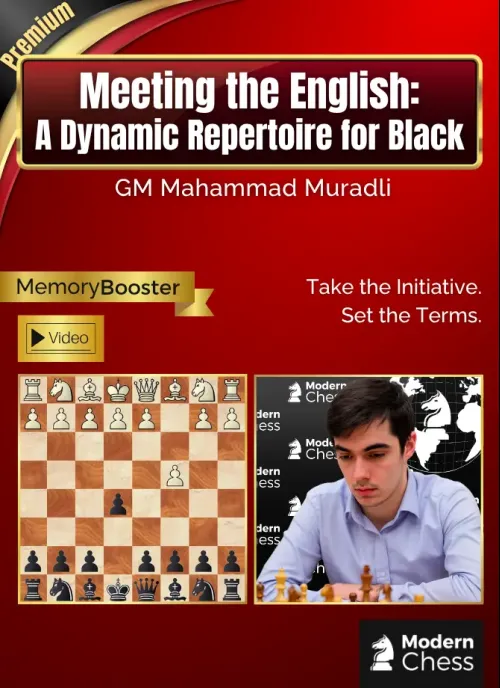
The English Opening can be like a Sicilian with an extra tempo, and White usually spends that tempo on comfort. Develop quietly, keep the centre fluid, wait to see how Black commits, and only then choose a plan. The whole appeal of 1.c4 is that White gets to be patient while Black reacts.
GM Mahammad Muradli's repertoire is built to take that comfort away. From the opening moves, Black becomes the side asking the questions — either out-waiting White with a quiet finesse, or forcing an immediate confrontation in the centre. The tempo may belong to White, but the initiative does not.
3h 59m PGN Available Memory Booster Interactive Tests Computer Practice
PGN Languages: