
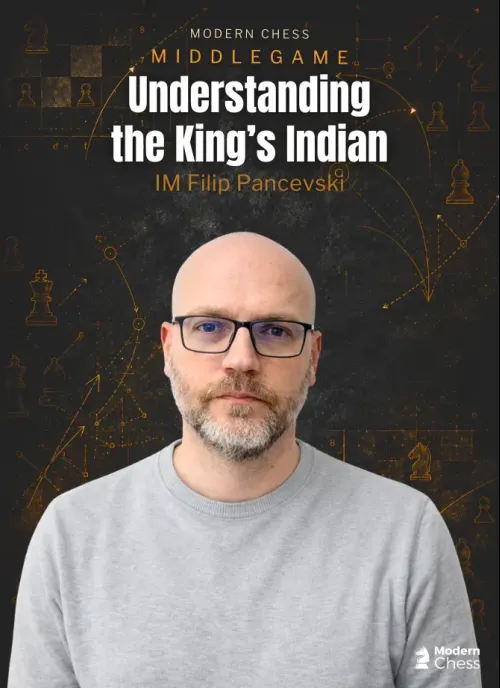
Zürich, 1953. At the Candidates Tournament where the King's Indian Defence was reborn, Svetozar Gligoric faced Alexander Kotov's Sämisch setup and gave up pawns to blockade White's centre.
The sacrifice opened the long diagonal for his g7 bishop and shut down White's bishop on d3. Within a few moves, White's pieces had been driven back to their starting squares. The game ended in a draw, but the idea has stayed relevant ever since.
For IM Filip Pancevski, it was the game that first taught him about the blockade. Decades later, he won a tournament game of his own with exactly the same idea. That connection between a classic idea and modern practice is what Understanding the King's Indian is built on.
5h 47m PGN Available Interactive Tests
PGN Languages:


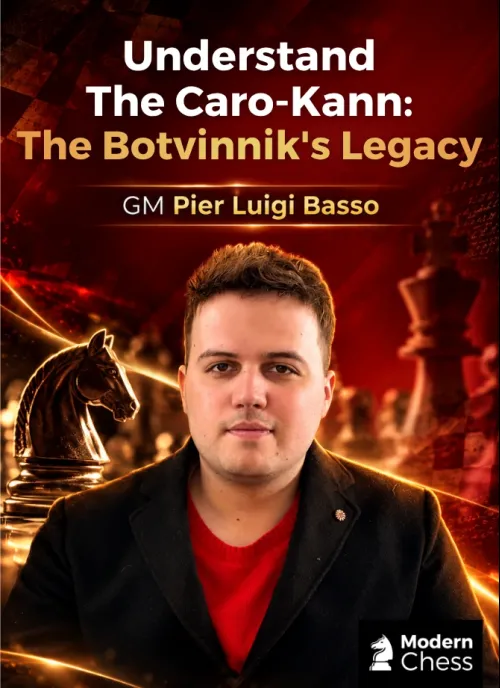
From intuition to system
Capablanca played the Caro-Kann by feel. Mikhail Botvinnik took the same opening, studied it, built it into a system, and carried it into World Championship matches. Without him, the Caro-Kann as it is played today would not exist.
That is the thread GM Pier Luigi Basso follows in the second part of his Caro-Kann Legacies series. He traces the modern opening back to Botvinnik, game by game.
3h 26m PGN Available Interactive Tests
PGN Languages:
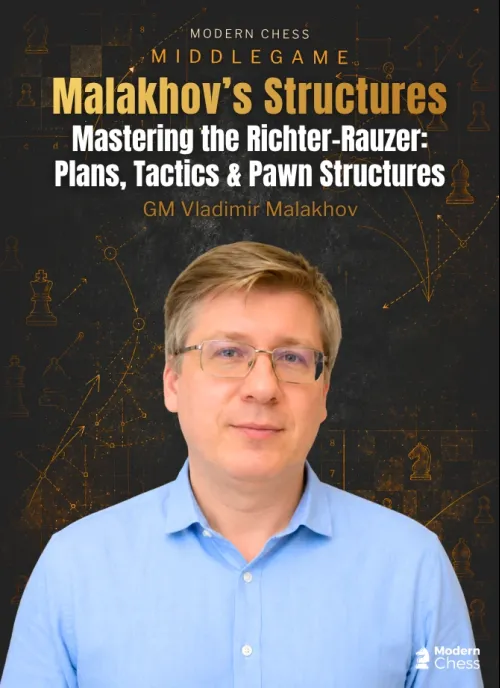
After Bxf6 gxf6, Black's position looks damaged: doubled f-pawns and a king with no comfortable home. Yet this is the Classical Sicilian, the oldest way to play the Sicilian and a choice of World Champions such as Botvinnik, Spassky and Kramnik.
The reason is a paradox at the heart of the Richter-Rauzer. Once the queens leave the board, the broken structure stops being a weakness and becomes a strength.
A structure, not a repertoire
After 1.e4 c5 2.Nf3 d6 3.d4 cxd4 4.Nxd4 Nf6 5.Nc3 Nc6 6.Bg5 e6, White usually plays Qd2, 0-0-0 and Bxf6. Black gets the bishop pair, the half-open g-file and a central pawn mass ready for ...e5 or ...d5.
White aims to open the position with f4-f5 or f4-e5 before Black’s bishops come alive. Black counters with ...a6, ...b5-b4 and the rook on the c-file, always looking for the right moment to trade queens.
3h 40m PGN Available Interactive Tests
PGN Languages:
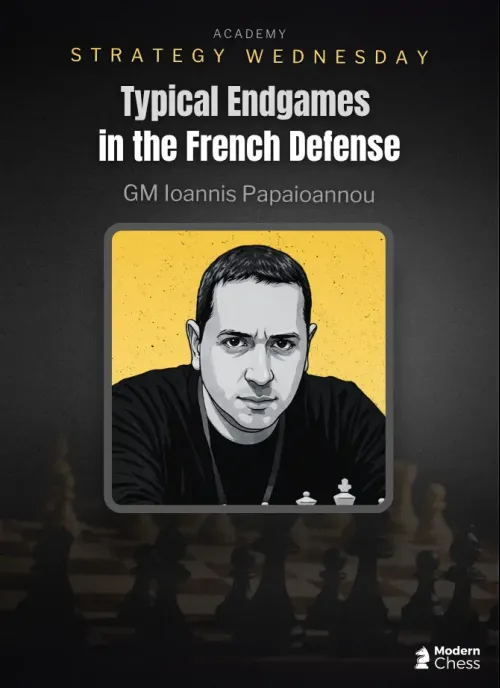
More than almost any other opening, the French is defined by its endgames — the middlegames flow again and again into the same recurring family of positions, and the player who understands them holds a lasting edge over the one who merely reaches them. Across four lectures, GM Ioannis Papaioannou covers the typical endings of the Advance, Tarrasch, Winawer and Exchange variations: the isolated-pawn structures and the critical light-squared bishop trade, the d4/e5 pawn chain, and the doubled c-pawns of the Winawer and MacCutcheon.
6h PGN Available Interactive Tests
At the 2026 Sinquefield Cup, Vincent Keymer had a positional resource that would have given him a clear advantage against Sindarov. He never found it. Twenty-six years earlier, in the same type of position, Nigel Short had passed over the very same idea.
Two players from completely different generations, both rated well above 2650, missing the identical point. That is the quiet danger of positional play: the mistake leaves no evidence. No blunder, no lost material — just a position that turns slightly worse while you are still convinced you played a solid game. The hardest part is learning to catch these moments yourself — and that recognition is exactly what Dreev's Universal Positional Playbook is built to train.
2h 54m PGN Available Interactive Tests
PGN Languages:
The Maroczy Bind carries the name of a player who never set it up with the white pieces. As Malakhov points out, Géza Maroczy — oddly enough — never played the structure as White at all; he appears on the Black side of the game that gave it its name, Swiderski–Maroczy, Monte Carlo 1904.
It is a fitting emblem for a structure that always had to be read from both sides of the board. The same two pawns on c4 and e4 can mean a slow, suffocating squeeze or a springboard for counterplay, depending entirely on who understands the position better.
That double vision is the premise of The Maroczy Bind - Strategic Foundations by GM Vladimir Malakhov. It is a structures course, not a repertoire — there are no long forcing lines to memorise. Instead it studies the formation itself: what each side is trying to do, which pieces to exchange and which to keep, where the pawn breaks live, and the exact moment a natural-looking move becomes a serious error.
Sequence: Universal Pawn Structures »
3h 59m PGN Available Interactive Tests
PGN Languages:
Material is the first thing chess teaches you to count, and the last thing you learn to distrust — the moment someone gives up the exchange for a square, the arithmetic stops working. This Guided Practice course trains the judgment that replaces it, across four themes: gambit play in attack and defence, positional exchange sacrifices, long-term piece sacrifices, and the remaining forms of imbalance. Examples run from Chigorin and Botvinnik to Anand, Shirov and Abdusattorov, with each exercise asking you to decide before the solution is revealed.
2h 10m PGN Available Interactive Tests
Where Part 1 treated pawns as structure at rest, Part 2 puts them in motion: the storm thrown at a castled king, the blockade that freezes an opponent's play, the defence that meets an avalanche, and the rook-pawn advance that modern practice has turned into a standard weapon. Petrosian anchors the blockading material, while Carlsen, Ding Liren and Gukesh illustrate the newest ideas. Four themes, trained the Guided Practice way — decide first, then compare.
2h 9m PGN Available Interactive Tests
Calculation is really two skills pulling in opposite directions: the fast, forcing sequence that decides an attack, and the quiet move that decides everything else. "What is the move that changes nothing — and yet changes everything?" — GM Dhopade trains both, from converting an attacking intuition into a concrete win to spotting the silent resource most players walk straight past. The most extensive exercise collection in the series, with full solutions, lecture recordings, and PGN.
6h PGN Available Interactive Tests
We are taught that strategy means quiet manoeuvring and calculation means tactics, but GM Dhopade's point is that strategic advantages often have to be calculated for — candidate moves and forcing lines used to win a positional argument rather than material. The course pairs that idea with a session on attacking combinations, which sharpen the same skill through sacrifice and pattern. Fifteen test positions with full solutions, plus complete lecture recordings and PGN.
6h PGN Available Interactive Tests