

The Owen Defence is one of the most interesting and original among hyper-modern openings. It combines ideas from several different openings, such as the Queen's Indian, the Bogo-Indian, the Nimzo-Indian and the Dutch. Black completely refrains from occupying the centre with his pawns and controls it with his pieces from afar, frequently involving the f-pawn in the process.
This database aims to offer a complete Owen repertoire against 1.c4 that avoids transpositions to the Queen's Indian or other main openings.
The database consists of 24 theoretical chapters and 16 interactive test positions.
2h 16m PGN Available Interactive Tests

In the introduction to the current database, GM Eljanov writes:
The Queen's Gambit Declined is truly a lifetime opening. Like no other it passed the test of centuries of chess practice. This opening was employed by almost all old maestros including Morphy, Chigorin and Steinitz as well as by modern super grandmasters like Carlsen, Ananda, Caruana and many others.
Different move orders were popular at different times. If in the old days it was considered safe to allow the Carlsbad Variation after 1.d4 Nf6 2.c4 e6 3.Nc3 d5, nowadays most modern maestros tend to avoid typical Carlsbad pawn chains with Black and opt for 3...d5 only in response to 3.Nf3.
Strangely enough, yours truly almost never played Queen's Gambit Declined with Black. Nevertheless, I suppose that it perfectly suits my style and chess philosophy. In this database, I decided to analyse Queen's Gambit Declined from Black's point of view and chose the most straightforward way to challenge the main move 5.Bf4 (after 1.d4 Nf6 2.c4 e6 3.Nf3 d5 4.Nc3 Be7 5.Bf4) with 6...c5!?. At some point, this move was a bit in the shadow of the solid 6...Nbd7 but recently it began to gain popularity again thanks to top GMs Nakamura, Caruana and Anand first of all.
PGN Available Interactive Tests

Welcome to the second (and final) database dedicated to the Bogo-Indian Defence.
Our starting position arises after the moves 1.d4 Nf6 2.c4 e6 3.Nf3 Bb4+ 4.Nbd2
There is a small psychological paradox connected with this move. It is true that 4.Bd2 avoids any early commitments, and is likely to maintain the fluency of White's play. But at the same time we have seen that with a minimum of accuracy, Black usually obtains a rock-solid position with good chances of counterplay. After 4.Nbd2 things are more double-edged strategically. While the knight is not optimally placed on d2, White launches an open invitation to what he hopes to prove an improved Nimzo-Indian, by forcing the exchange on d2 with a2-a3, thus avoiding the doubled pawns on the c-file. But at the same time, the last move restricts White's choice of plans, allowing Black to more or less dictate the middlegame structure.
PGN Available Interactive Tests

In his first database for Modern Chess, the Ukrainian FM Yuriy Krykun builds a very challenging yet underestimated weapon against the Grunfeld Defence. The first important position of his repertoire arises after 1.d4 Nf6 2.c4 g6 3.Nc3 d5 4.cxd5 Nxd5 5.e4 Nxc3 6.bxc3 Bg7 7.Nf3 c5 8.Bb5+
PGN Available Interactive Tests

The suggested repertoire for Black in the Bogo-Indian with 4.Bd2 is both rock-solid and ambitious. Despite White’s space advantage and apparent superior activity, Black can not only keep his own but also find promising ways to counterplay. Many of Black’s wins were possible because of White’s over-optimism in the attempt to use his trumps. The magic of this system is even more obvious when comparing with the King’s Indian, a supposedly more aggressive opening leading to similar structures but with the dark-squared bishops on board.
This repertoire does not require memorizing long forced lines, as the focus is on understanding the typical structures.
PGN Available Interactive Tests

This variation might be a serious contender replacing the Old Main Line. It does, in my opinion, indeed lead to much more adventurous position than current Main Line of the Catalan, reached after 4...Be7 5.Bg2 0-0 6.0-0 dxc4. One little warning, or rather see it as an encouraging message, particularly the Main Lines after 4...dxc4 5.Bg2 a6, covered in the last chapters contain an incredibly deep, computer-assisted analysis.
We aren't playing this system to equalize, but rather try to put White under pressure by sticking to our extra pawn. We are looking for our own chances! Most of the Chapters offer imbalanced pawn structures or material distribution, offering good practical chances to play for a win, once we leave the theoretical territory.
PGN Available Interactive Tests

In the second database of his English series, GM Michael Roiz completes his repertoire after 1.c4 e5 2.g3. Contrary to Part 1, with rare exceptions, the current database features systems in which the play is more positional. Therefore, when studying this database, one should mostly concentrate on the understanding of the typical pawn structures and plans.
In what concerns the theory, true to his approach, GM Roiz always tries to come up with original and less explored concepts.
PGN Available Interactive Tests

The English Opening has always been one of White's most fundamental choices. You will hardly find a top-level player who does not have this opening in his repertoire. Nowadays, in our computer-driven era, English Opening is getting even more popular. The reason is that it is by no means simple for the opponent to prepare against 1.c4. Since the pawn structure is very flexible, we have a wide range of options on every move. Therefore, in most of the lines, general understanding tends to be more important than knowledge of concrete lines.
One of the most critical responses to 1.c4 is 1...e5. Black immediately grabs space in the centre and obtains a Sicilian position with colours reversed. In this database, GM Roiz starts building a complete repertoire against 1...e5. His repertoire is based on 1.c4 e5 2.g3.
PGN Available Interactive Tests
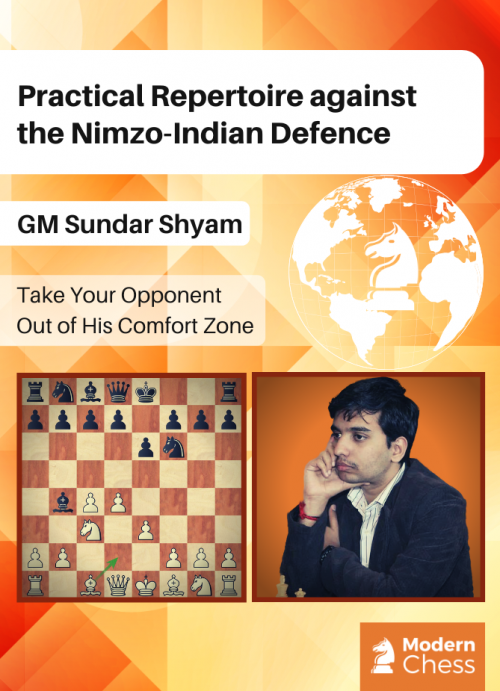
The Nimzo-Indian Defence has always been one of Black's most challenging weapons against 1.d4. How should we meet this opening? The main lines require enormous theoretical knowledge (you should invest a lot of time to study them) while there is no advantage. The modern computers demonstrated more than one way to equalize in all the main systems. Therefore, a more practical approach would be to focus on creating practical problems. In order to achieve it, it is enough to obtain a non-trivial position that you know better than your opponent.
In the current database, GM Sundar Shyam advocates exactly this approach. His repertoire is based on the line 1.d4 Nf6 2.c4 e6 3.Nc3 Bb4 4.e3 0-0 5.Bd2!? (Black's alternatives on move 4 are also dealt with).
The database is divided into three sections - Model Games, Theory, Test Positions. You will find 5 model games, 10 theoretical chapters and 12 interactive test positions.
PGN Available Interactive Tests
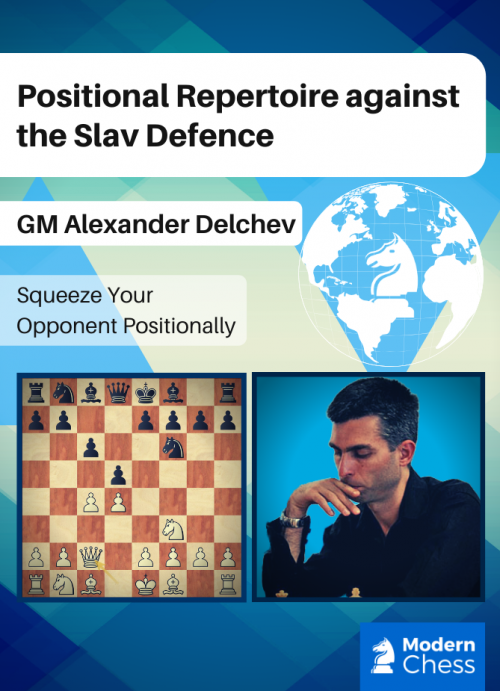
The Slav Defence is one of the most solid ways to meet 1.d4. Therefore, this opening has always been an evergreen choice in high-level chess. Building a repertoire for White is really challenging. Since there is no way to achieve an objective advantage, White shall try to create practical problems and outplay in opponent in strategically complex positions.
In the current database, GM Aleksander Delchev builds a positional repertoire for White. The starting position of his survey arises after 1.d4 d5 2.c4 c6 3.Nf3 Nf6
The main repertoire suggested by GM Delchev is based on 4.Qc2. As an alternative, he also provides a backup repertoire with 4.Qb3. Having two options (which are quite similar strategically) allows you to adjust your choice depending on your opponent.
As already mentioned, this is a positional repertoire. Hence, the understanding of the typical plans and ideas is much more important than the memorization of theoretical lines. Therefore, the author provides an extensive examination of the typical pawn structures.
PGN Available Interactive Tests

