

The workshop dedicated to the Catalan Opening is already a digital product. This product includes all the videos from the workshop as well as the PGN file related to the training sessions. Overall, the material consists of approximately 7 hours of video and a PGN database which includes 60 files!
You will find the following lectures:
Typical Pawn Structures - GM Petar Arnaudov
Typical Attacking and Tactical Ideas - GM Mihail Marin
Modern Theoretical Trends - GM Boris Avrukh
Master the Catalan Endgames - GM Grigor Grigorov
Sequence: Fianchetto Pawn Structures »
6h PGN Available Interactive Tests

After writing his trilogy for the Anti-Sicilian approach, GM Neiksans decided to write something similar about the ever-tough Caro-Kann as well. He suggests an easy-to-learn setup which according to several Caro-Kann experts is the most annoying system for a Caro-Kann player to face!
The database contains 10 theoretical chapters and 18 interactive test positions.
2h 4m PGN Available Interactive Tests

As the author explains, “The first game that featured this line was played, according to my database, back in 1952! But, the next one took place only in 1983, and generally, this line was considered lame and never saw the spotlight until 2018-2019, where all the elite players suddenly picked it up! White is tempting Black to trade queens and go for the endgame. This endgame will be very similar to the Philidor endgame and to the Anti-Grunfeld one, but with some additional perks for White as ...c7-c6 proves a rather weakening move. ”
This is a very compact and practical piece of research.
The current database consists of 8 theoretical chapters, 2 model games and 8 test positions.
1h 34m PGN Available

Symmetrical English is one of the most strategic openings. In order to play with success, one needs a very good understanding of the typical positional ideas and pawn structures. There are no so many lines that require memorization. Therefore, this repertoire is very attractive for people who are tired of studying long computer preparations.
The current database consists of 3 sections - Typical Positions, Theory, and Test Section. In other words, you will find 16 must-know typical positions, 16 theoretical chapters, and 15 interactive test positions.
PGN Available Interactive Tests
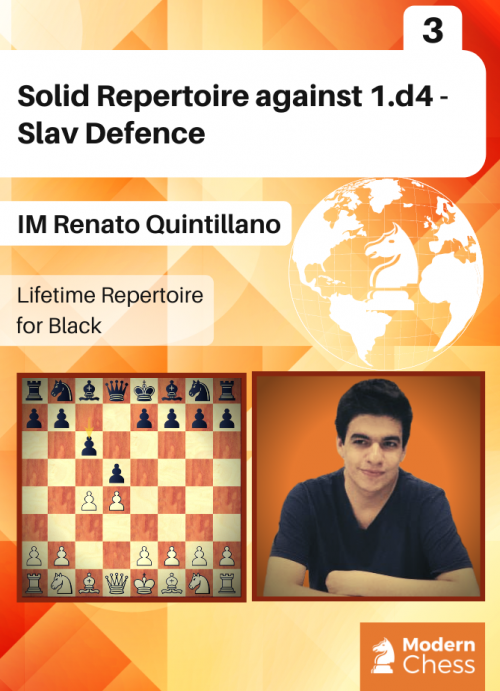
In his third, final database on the Slav IM Quintillano focuses on the highly important and critical tabiya which arises after 1.d4 d5 2.c4 c6 3.Nf3 Nf6 4.Nc3 dxc4 5.a4 Bf5 6.Ne5
As Renato himself admits, he did not except this position to be THIS theoretically demanding and challenging. To quote the author: “If I had been told before that the whole database would be required in order to cover one position, I would laugh hard. But, the arising positions turned out to be so complicated and interesting!
I am very happy with the result of this research as I believe I've done a great job and now the readers can be very confident about the opening outcome and the arising middlegame positions.”.
PGN Available Interactive Tests

Zahar Efimenko is not only an extremely strong GM but also a famous coach and Vladimir Kramnik's former second. His theoretical research is known for its profoundness as well as the amplitude of fresh ideas.
In his current database, which happens to be his second work for Modern Chess, he comes up with a solution to a very significant issue – how to meet the Anti-Sicilians?
Any Najdorf, Dragon and whatnot player studies his favourite Open Sicilian variations and learns them by heart. But, what to do when it comes to the nasty 3.d4 cxd4 4.Qxd4 or 3.Bb5+? This is what this work is about.
The current database consists of 12 theoretical chapters and 15 interactive test positions
PGN Available Interactive Tests

This is the second part of the repertoire – in Part 1, he analyzed 3...dxe4 and 3...Nf6.
In this database, Ruslan covers such sidelines as 3...Nc6 and 3...h6 before moving on to the dreaded Winaver Variation 3...Bb4.
His current work consists of 9 theoretical chapters and 2 model games that would allow you to deepen your positional understanding of the standard plans, ideas and manoeuvres while also recalling and learning the tactical nuances. Additionally, in the Test Section, you will find 15 interactive test positions.
PGN Available Interactive Tests

In this database, IM Renato Quintillano comes up with the second part of his three-part series on the Slav Defense.
As you know, the first part was devoted to sidelines and interesting attempts White can throw at Black early on.
The current work is dedicated to the very serious mainlines after 1.d4 d5 2.c4 c6 3.Nf3 Nf6 4.e3 as well as 4.Nc3.
PGN Available Interactive Tests

This pawn structure usually arises after 1.e4 e5 2.Nf3 Nc6 3.Bb5 from one of the following lines:
A) 3... a6 4.Bxc6 (Exchange Spanish)
B) 3...a6 4.Ba4 Nf6 5.Bxc6 or 5.0-0 Be7 6 Bxc6 (Delayed Exchange Spanish)
C) 3...Nf6 4.Bxc6 (Anti-Berlin)
In the introduction, GM Aleksander Delchev writes: n my survey, I deal with this position both from White and Black's perspective. Besides improving your play in the abovementioned theoretical lines, this material is designed to improve your general chess understanding as well. Hopefully, you will get a better feeling of the following strategical aspects: play with and against a bishop pair, find the right plan and execute the right pawn break in static structures, the importance of the space advantage, play positions with opposite castles. Additionally, I am sure that this database will help you to increase your endgame technique since I provide a number of instructive examples.
Sequence: 1.e4 Pawn Structures »
PGN Available Interactive Tests

In his second database for Modern Chess, the Ukrainian FM with 2 IM norms and an experienced coach Yuriy Krykun analyses the pesky sidelines and interesting mainlines that arise after 1.Nf3 d5. He focuses on three continuations: 2.g3, 2.c4 and 2.b3.
As Yuriy himself explains, “While for some players those move orders don't present much of a difficulty: say, most Slav players would meet 2.c4 with 2...c6, while QGD players will play 2...e6, it is a very important subject to cover. The reason is that for one, those move orders are often tried to get you out of book or move-order you in some line you might not want to play. Secondly, the suggestions presented here are universal and would suit you no matter what your main opening after 2.d4 is – whether it is the Slav, Queen's Gambit Declined, Queen's Gambit Accepted, or anything else. And, finally, it is always nice to have some variety as opposed to being forced to play what White wants: the Anti-Meran, the Anti-Queen's Gambit, etc”.
The current database contains 11 theoretical chapters and 15 test positions that would check both your tactical and positional knowledge, as well as how carefully you have remembered some important opening ideas and move orders.
1h 46m PGN Available Interactive Tests

