
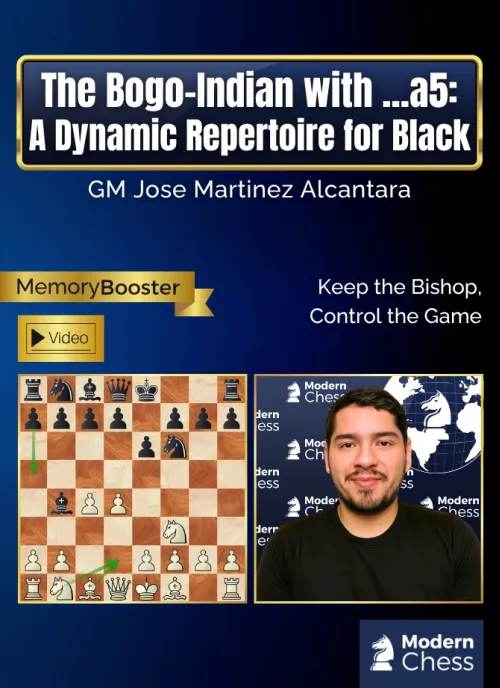
After 1.d4 Nf6 2.c4 e6 3.Nf3 Bb4+ 4.Bd2, Black faces the Bogo-Indian's oldest question: what to do about the bishop on b4. Trade it, defend it with the queen, or strike with ...c5?
GM Jose Martinez Alcantara chooses a fourth path. The modest rook-pawn move 4...a5!? anchors the bishop, keeps the tension, and prepares the classic Bogo-Indian setup with the d6–e5 pawn chain.
Why ...a5?
The author's goal is simple: fighting positions in which Black dictates the character of the game. After 3.Nf3, the Bogo-Indian denies White the familiar Catalan structures and steers the game toward a different kind of struggle.
The ...a5 move does more than defend b4. In many lines the pawn moves on to a4, squeezing the queenside and making it harder for White to make progress on that side of the board. Against 5.Bxb4 axb4, the structural transformation keeps Black's chances to play for all three results.
2h 27m PGN Available Memory Booster Interactive Tests
PGN Languages:


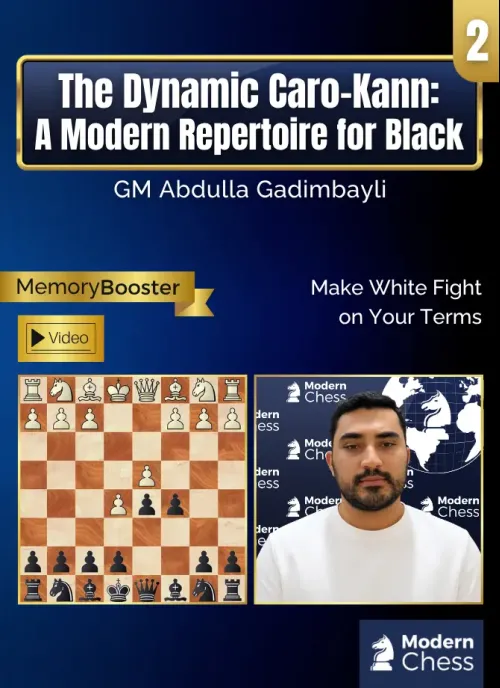
Over the past few decades, the Advance Variation has become one of White's most flexible weapons against the Caro-Kann. After 1.e4 c6 2.d4 d5 3.e5, White usually gets to choose the character of the fight: a slow build-up with 4.Nf3, an aggressive 4.h4, a sharp 4.Nc3 with g4, or an early 4.g4.
The underlying idea of this course is simple and demanding: take that choice away. With 3...c5, Black strikes at the center at once and moves the game onto his own terms.
1h 48m PGN Available Memory Booster Interactive Tests
PGN Languages:
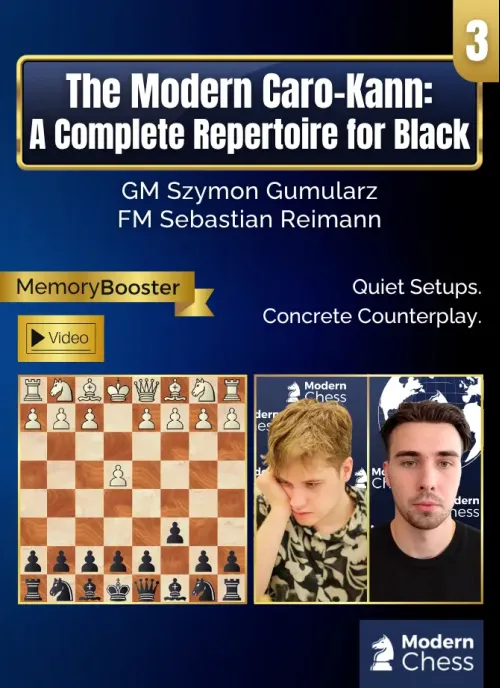
There is a paradox every Caro-Kann player knows. The Classical and the Advance are the most critical tests, yet many games never reach them.
White plays 2.Nf3, 2.d3, 2.d4 with 3.f3, or the Two Knights, and the theoretical battle you prepared for disappears. These lines are less critical on paper, but they show up all the time in practice.
The Modern Caro-Kann: A Complete Repertoire for Black – Part 3 is built on a clear goal. Black should not simply survive these sidelines. Black should be happy to see them.
3h 5m PGN Available Memory Booster Interactive Tests Computer Practice
PGN Languages:
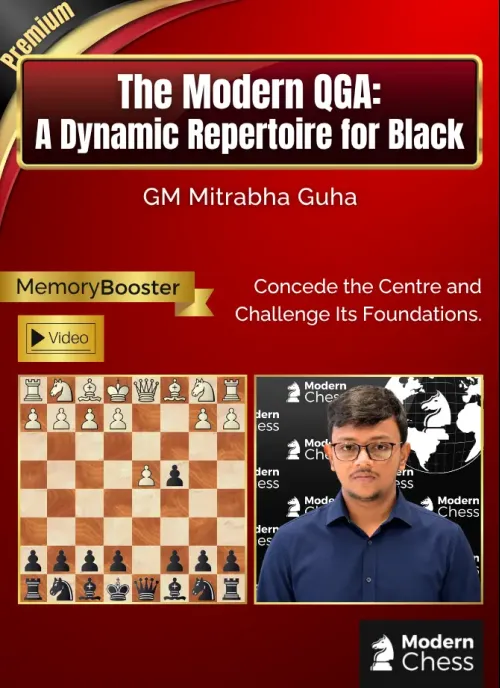
The Queen's Gambit Accepted carries a slightly misleading name. Black takes on c4, but the pawn is rarely the point. The real bargain is time and space: White is invited to build a broad centre, and Black's entire strategy is built around challenging it before it becomes too strong.
That paradox, giving up the centre in order to attack it, is the leitmotif of The Modern Queen's Gambit Accepted: A Dynamic Repertoire for Black by GM Mitrabha Guha. After 2...dxc4, Black's typical plan is ...c5 and, at the right moment, ...cxd4. If White recaptures with the e-pawn, the isolated d4-pawn can become a long-term target. If White recaptures with a piece, the position opens up with roughly equal chances.
3h 8m PGN Available Memory Booster Interactive Tests Computer Practice
PGN Languages:
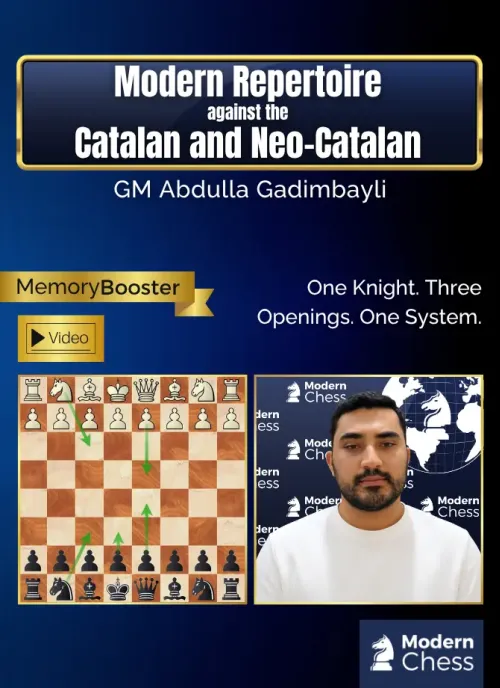
Every player who meets 1.d4, 1.Nf3 and 1.c4 knows the problem. Against a strong, well-prepared opponent, Black rarely gets the opening he prepared for. White can choose the Catalan, slip into a Neo-Catalan move order to sidestep the main theory, or stay in Réti territory altogether.
Each choice normally demands its own repertoire, its own files and its own hours of study.
GM Abdulla Gadimbayli's answer is a single move: ...Nbd7. In The Catalan with ...Nbd7: A Modern Repertoire for Black, the knight goes to d7 in every line, against the Catalan, the Neo-Catalan and the Réti alike.
2h 8m PGN Available Memory Booster Interactive Tests
PGN Languages:
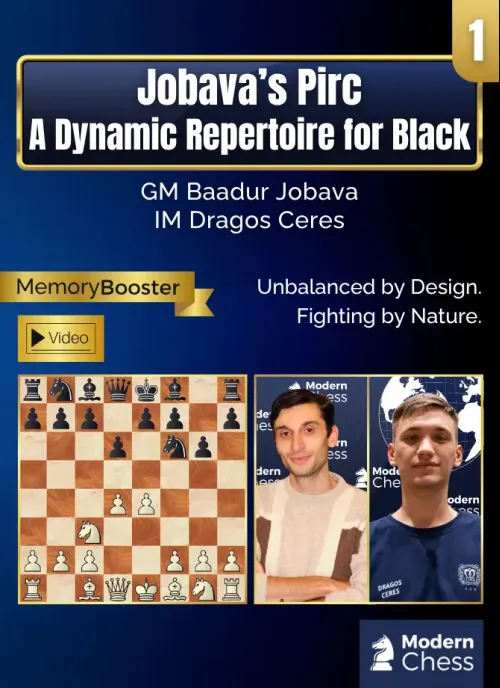
GM Baadur Jobava opens with a direct admission: he hates it when White decides the game is a draw at move ten. The Pirc is his answer — Black hands over the centre deliberately, lets White build it, and then takes it apart, so that every White plan carries a concrete price and there is no early simplification, no dead symmetry, and no forced route to a draw. Part 1 is anchored in the Austrian Attack across six chapters, with the Classical System, the Italian-style 4.Bc4 and the Fianchetto System completing it — and the author singles out the position after 7.O-O e5! as the most important chapter in the course.
3h 5m PGN Available Memory Booster Interactive Tests
PGN Languages:
The first volume of a new six-month project, and it begins where the French itself begins: the Advance Variation and the archetypal pawn chain of d4 and e5 against d5 and e6, from which almost every strategic idea in the opening can be traced — the ...c5 break at the base, the pressure on d4 with ...Qb6 and ...Nc6, and the long-standing question of the light-squared bishop. GM Grigor Grigorov devotes two full lectures to the structure itself before any concrete line, then turns to the closed positions after 6.a3 c4 and the sharp gambit lines after 6.Bd3 cxd4. Theory is kept intentionally light — the aim is to enter the middlegame knowing what you are playing for, not to memorise sequences.
6h PGN Available Interactive Tests
The final volume of the six-month Réti project, and the one that completes the system. Where Theoretical Knowledge, Part 1 answered everything Black tries with ...d5, Part 2 takes on the whole remaining field: the Réti Slav and the Tarrasch Defence, the Hedgehog and double fianchetto, the Dutch in both its Leningrad and Stonewall forms, the Symmetrical English and the Wedberg System, the King's Indian Fianchetto — and the ...g6 setups, met with a clear decision to play 2.e4. Theory is given where theory is required, but always on top of the structures built across the first four months, which is why it can be absorbed quickly rather than memorised painfully.
6h PGN Available
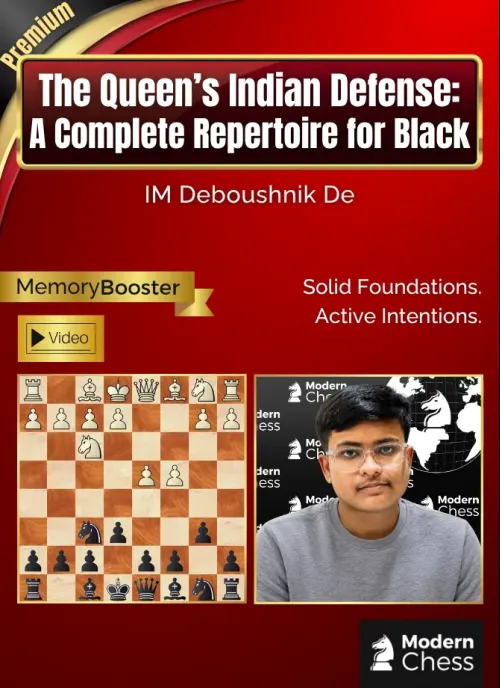
The Queen's Indian Defence is a classical opening, usually valued more for its solid positional foundation than for its fighting potential. IM Deboushnik De's new repertoire keeps that foundation but adds novelties, ambitious ideas and aggressive lines that let Black fight for the initiative.
The central idea goes back to Aron Nimzowitsch. His 4...Ba6, aimed straight at the c4-pawn, turns a developing move into a question White has to answer immediately. The repertoire is built around that question, and around a broader principle: Black's setup should be decided by what White has already committed to.
4h 48m PGN Available Memory Booster Interactive Tests Computer Practice
PGN Languages:
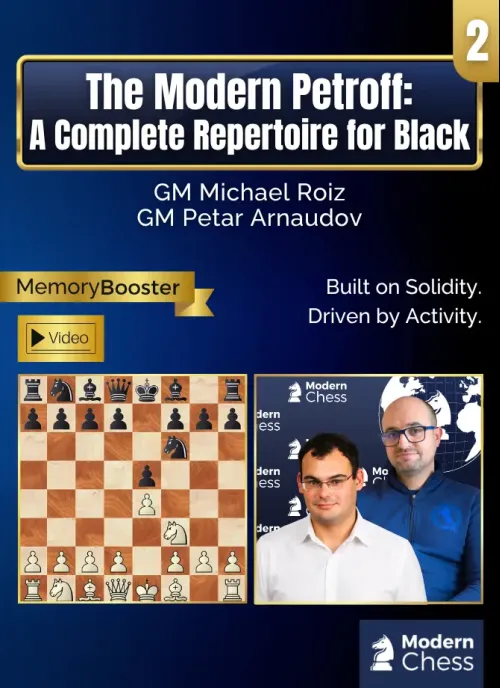
With 3.d4, the Steinitz Variation, White opens the centre at once. The promise behind the move is easy to understand. The position opens before Black has finished development, and White hopes the open lines will favour the side that moves first.
The Modern Petroff: A Complete Repertoire for Black – Part 2, by GM Michael Roiz and GM Petar Arnaudov, turns that promise around. After 3...Nxe4, Black's pieces come out quickly. In many lines Black is ready to give up a pawn in return for activity and pressure on White's centre.
1h 40m PGN Available Memory Booster Interactive Tests
PGN Languages:

