

After 1.d4 Nf6 2.Nf3 e6, most White players face a choice they have made a hundred times: play 3.c4 and step into the vast, well-mapped territory of the Queen's Gambit and the Nimzo-Indian, where the opponent's preparation is usually waiting. This course is built on a different third move. With 3.Bg5 — the Torre Attack — White sets the strategic agenda at once, sidesteps the heavily prepared mainstream, and steers the game into positions where understanding decides far more than memorisation.
10.5h PGN Available

Most players who open 1.d4 accept an unspoken bargain: in exchange for a sound, ambitious first move, they agree to meet whatever their opponent has prepared — the Nimzo-Indian, the Grünfeld, the King's Indian, the Queen's Gambit Declined, each with its own library of theory. This course is built on refusing that bargain. With 2.Bg5, White sets the strategic agenda from the second move, sidesteps the heavily prepared mainstream defences, and steers the game into positions where understanding matters far more than memorisation.
10.5h PGN Available

Every opening asks you to pay for something, and the Tarrasch Defense names its price out loud. In return for free development, active pieces and a clear plan, Black accepts a long-term structural weakness — most often the isolated pawn on d5. The moves that reach that position have shifted across a century of practice; the pawn on d5, and the plans it demands, have barely moved at all.
That constancy is the entire premise of Tarrasch Defense - Strategic Foundations by IM Dragos Ceres and GM Vladimir Malakhov. It is built not as a theoretical file but as a study of the structures behind it— because, as Malakhov puts it, once you recognize the structure you already know the plan.
Sequence: Universal Pawn Structures »
PGN Available Interactive Tests
PGN Languages:


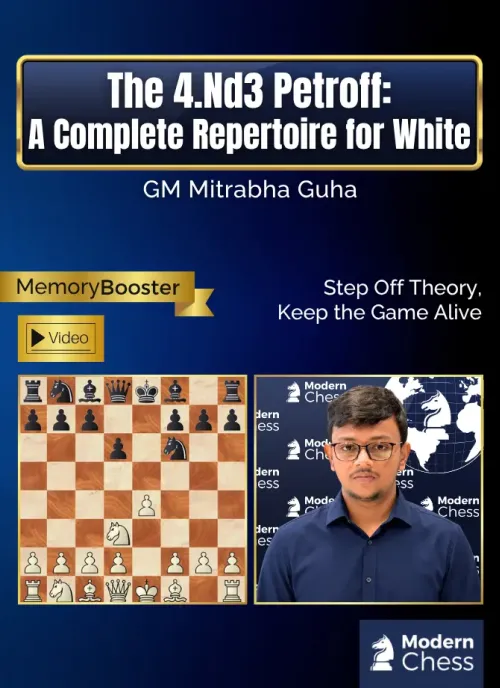
The Petroff Defence built its reputation on solidity. Black answers 1.e4 e5 2.Nf3 with 2...Nf6, invites the symmetry, and heads for the well-charted lines where the pieces come off and the game settles toward a quiet, reliable draw. It is the opening you reach for when you want certainty against 1.e4. GM Mitrabha Guha's repertoire is built to take that certainty away.
After 1.e4 e5 2.Nf3 Nf6 3.Nxe5 d6, the routine move is 4.Nf3, stepping back into theory a Petroff specialist knows well. Guha goes the other way with 4.Nd3. The knight retreats to an unusual square, keeps every piece on the board, and declines the simplifying trades the whole opening is designed to reach. What Black came for was a theoretical duel down familiar paths; what Black gets is a fresh middlegame with the character still undecided.
1h 7m PGN Available Memory Booster Interactive Tests
PGN Languages:

For most of its life, the Vienna Variation asked Black to walk a tightrope. After 1.d4 Nf6 2.c4 e6 3.Nf3 d5 4.Nc3 dxc4 5.e4, the classical road ran through 5…Bb4 — the pin on c3, the threat of …Nxe4, and behind them a thick layer of forcing theory that every prepared opponent had already memorized.
GM Baadur Jobava and GM Pier Luigi Basso take a sharper turn. Grab the pawn on c4 and keep it, then answer 5.e4 with the immediate 5…b5 — defending the extra c4-pawn before White can round it up, and steering the game into wild, unbalanced positions where Black can also be the one playing for a win from move five.
1h 43m PGN Available Memory Booster Interactive Tests
PGN Languages:

In 1918, at Berlin, Milan Vidmar reached for an opening that barely anyone took seriously. It was a pawn sacrifice first tried by the Hungarian master Maróczy in a casual game back in 1896, and Vidmar used it to defeat Akiba Rubinstein — one of the finest technicians the game has ever produced.
That single result pulled the Budapest Gambit out of obscurity and sparked a wave of popularity through the early 1920s. It has been a rare guest at the top ever since.
But the reason Vidmar's idea worked has never gone away. After 1.d4 Nf6 2.c4 e5, Black hands over a pawn and receives, in return, rapid development and pieces that come to life at once.
3h 22m PGN Available Memory Booster Interactive Tests
PGN Languages:

For a long time, 3.f3 against the Caro-Kann lived up to the faintly dismissive name it was given. The Fantasy Variation was treated as a club-level ambush, a line to spring on an unprepared opponent rather than a serious try for an opening advantage. That reputation is now out of date.
Modern engines evaluate many of the critical positions after 1.e4 c6 2.d4 d5 3.f3 as comfortable for White, and the move has crossed over from the world of surprise weapons into the repertoires of top grandmasters. What was once "fantasy" has become a grounded, objectively sound way to fight for the center from the third move.
1h 48m PGN Available Memory Booster Interactive Tests
PGN Languages:

The Benoni has always carried a reputation against the fianchetto. Play 3.g3, allow 3...c5, and conventional wisdom says Black has found the right answer — the g3-setup is supposed to be exactly what the Benoni player wants to see.
In The Catalan against an Early ...c5, GM Pier Luigi Basso neither disputes that reputation nor avoids it. He accepts it and turns it around. The Benoni is a good option for Black. It is also, as the course sets out to demonstrate, a very good one for White. The author's own description of the strategy is worth keeping in mind throughout: invite the opponent into your territory, let them believe they have achieved something, and let them regret the choice later.
2h 11m PGN Available Memory Booster Interactive Tests
PGN Languages:

When English club players of the 1980s needed something reliable against the Pirc and Modern, many reached for the same recipe: Be3, Qd2, f3, long castling, and a pawn avalanche with h4-h5. The system picked up a nickname — the 150 Attack — because a player graded around 150 on the old British scale, roughly 1800 today, could handle it without memorising a lot of theory. The plan carried the ideas; the burden on memory stayed light.
Crushing the Modern Defence inherits that logic and gives it grandmaster precision. In the Modern, Black concedes the centre on purpose, intending to strike back at it from the flanks once the hypermodern set-up is complete. Roiz and Arnaudov reply before that plan matures — occupy the centre, castle queenside, and pry open the h-file with h4-h5 while the opponent is still arranging his pieces. In line after line White gains space and leaves Black cramped.
58m PGN Available Memory Booster Interactive Tests
PGN Languages:

With 4.Bg5, White tries to change the subject. Rather than the direct 4.e5 that Part 1 was built to answer, the bishop develops and invites the French player onto different ground. Stella's reply, 4...Be7, quietly declines the argument — after 5.e5 the game folds straight back into the Steinitz pawn chain the whole repertoire is built around. The move meant to sidestep the Steinitz becomes another road into it.
5h 14m PGN Available Memory Booster Interactive Tests
PGN Languages:

