
This course examines the endgames arising from three related White systems — the London System, the Torre Attack, and the Trompowsky — which share a common structural logic: the early commitment of the queen's bishop and the recurring pawn formations, most often Carlsbad structures, that follow. The course addresses how dark-square strategy carries into the endgame and how small but durable structural advantages are converted through precise technique and accurate piece placement.
6h PGN Available Interactive Tests
PGN Languages:

This course examines the endgames arising from the Sicilian Defense across its principal variations, including the Najdorf, Scheveningen, Taimanov, Classical, Sveshnikov, and Dragon. It focuses on the structural features that determine endgame evaluation — the d5-square, the half-open c-file, pawn majorities, weak squares, and minor-piece imbalances — and on the techniques required to exploit or defend long-term positional advantages. Central themes include the transition from middlegame to endgame, king centralization, the bishop pair, opposite-colored bishops, and the conversion of subtle structural edges into full points.
6h PGN Available Interactive Tests
PGN Languages:
After 1.d4 Nf6 2.c4 e6 3.Nf3 c5 4.e3 d5, the game reaches an isolated queen's pawn structure that belongs to no single opening — the very same positions arise from the Panov Attack, the Semi-Tarrasch, the Queen's Gambit Declined and the Symmetrical English, so learning to handle them once pays off for the rest of your career. Across seven lectures, GM Ioannis Papaioannou begins with two full sessions on the attacking ideas and technical procedures of the structure itself, then builds the concrete repertoire on top: the immediate 4...d5, the Panov tabiya after 5.exd4 d5, and Black's attempts to stay flexible.
10h 37m PGN Available Interactive Tests
More than almost any other opening, the French is defined by its endgames — the middlegames flow again and again into the same recurring family of positions, and the player who understands them holds a lasting edge over the one who merely reaches them. Across four lectures, GM Ioannis Papaioannou covers the typical endings of the Advance, Tarrasch, Winawer and Exchange variations: the isolated-pawn structures and the critical light-squared bishop trade, the d4/e5 pawn chain, and the doubled c-pawns of the Winawer and MacCutcheon.
6h PGN Available Interactive Tests
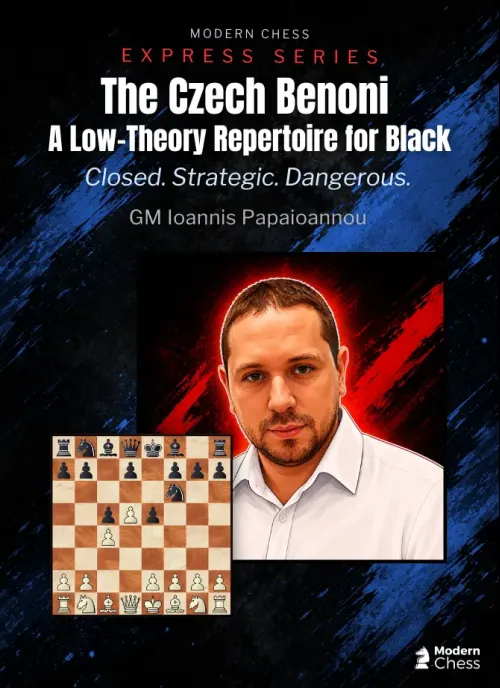
After 1.d4 Nf6 2.c4 c5 3.d5 e5, the Czech Benoni gives the game a closed, strategic character where knowing the plans matters far more than knowing the theory — you need only the basic scheme of development and the typical middlegame ideas against White's four main setups. GM Ioannis Papaioannou is candid that the engine is unenthusiastic about Black's position, and argues that this is precisely the system's strength: in practical play Black scores well, because the opponent has almost certainly never studied these structures. Taught entirely through model games and educational examples, it is the second course in his Low-Theory Repertoires series — a complete answer to 1.d4 without months of memorisation.
Sequence: Express Series »
3h 59m PGN Available

After 1.d4 Nf6 2.Nf3 e6, most White players face a choice they have made a hundred times: play 3.c4 and step into the vast, well-mapped territory of the Queen's Gambit and the Nimzo-Indian, where the opponent's preparation is usually waiting. This course is built on a different third move. With 3.Bg5 — the Torre Attack — White sets the strategic agenda at once, sidesteps the heavily prepared mainstream, and steers the game into positions where understanding decides far more than memorisation.
10.5h PGN Available

Most players who open 1.d4 accept an unspoken bargain: in exchange for a sound, ambitious first move, they agree to meet whatever their opponent has prepared — the Nimzo-Indian, the Grünfeld, the King's Indian, the Queen's Gambit Declined, each with its own library of theory. This course is built on refusing that bargain. With 2.Bg5, White sets the strategic agenda from the second move, sidesteps the heavily prepared mainstream defences, and steers the game into positions where understanding matters far more than memorisation.
10.5h PGN Available

Most players who face 1.Nf3 d5 reach for the classical 2.g3 Réti or transpose with 2.c4 — GM Ioannis Papaioannou offers a third path with 2.b3, keeping all the flexibility of the Réti while sidestepping its most analysed theory. Built from his camp on the system, the course meets every Black setup — ...Bf5, ...Bg4, ...e6, ...g6 and ...c5 — with clear plans built on long-range pressure from the b2-bishop, the well-timed light-squared-bishop trade, and a principled d2–d4. The result is a complete, low-theory repertoire for White that poses real problems from the very first moves — preparation your opponents are rarely ready for.
10h 30m PGN Available

The London System without the memorisation: GM Ioannis Papaioannou presents a practical, low-theory repertoire for White built on understanding the structures rather than recalling forced lines. Organised by Black's setup and taught through model games from elite practice — Carlsen, Ding Liren, Giri, Aronian and others — it gives club players a complete, ready-to-play weapon and stronger players a reliable, time-efficient addition to their 1.d4 arsenal.
Sequence: Express Series »
4h PGN Available

This course is the next step in our series offering a complete 1.e4 e5 repertoire for Black, following two related projects: Italian Game for Black — Deep Understanding and The Spanish Arkhangelsk with Early ...Bc5 — Deep Understanding. With the Scotch Game, the series now completes one of the most important parts of the 1.e4 e5 universe.
For many players, the Scotch is one of the most unpleasant openings to face. It often leads to irrational positions, where standard plans do not apply and concrete understanding becomes critical — exactly the type of position where preparation based on memorisation breaks down. This course offers a solution built on deep understanding of the arising structures, plans, and practical decisions.
10.5h PGN Available

